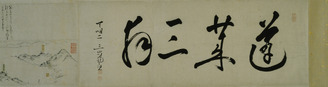
Kumano Pilgrimage
A pilgrimage to the three shrines of Kumano, popular from the Heian period through the Muromachi period
A Kumano pilgrimage involved making a pilgrimage to the three shrines of Kumano. It became popularized in the Heian period (795–1180). An early record referencing it is a travel account written by the monk Zoki and titled Io nushi (Hermitage Keeper). From the time of the cloistered Emperor Uda to the retired Emperor Kameyama, about 100 imperial pilgrimages have been made, with 34 pilgrimages made by the retired Emperor Goshirakawa and 28 made by the retired Emperor Gotoba. Included in retired Emperor Goshirakawa’s anthology Ryojin hisho (Songs to Make the Dust Dance) is the song “Routes to great compassion, be they the road to Ki or the road to Ise, are not far off.” Details of a pilgrimage by Emperor Gotoba are described in the Kumano goko ki (Imperial Visit to Kumano), by Teika Fujiwara, who attended Emperor Gotoba in 1201. The Kamakura period (1180–1333) brought more visits by samurai, and the Muromachi period (1392–1507), more visits by commoners. So numerous were pilgrims that the state of a pilgrimage to Kumano has been described as “a pilgrimage of ants to Kumano.” The route of the pilgrimage is called the Kumano Kaido (or Kumano Kodo). Routes from Yamato and Yamashiro to Kumano, which are separated by mountains and sea, were all challenging, and so had the character of religious training routes. The Kii route from the capitol, Kyo (Kyoto), went through Nanba, along the coast to Tanabe (in Wakayama Prefecture) and from Tanabe along the Nakahechi route through the mountains to Hongu Shrine. Along this route the 99 Oji Shrines of Kumano were set up for worship. There remain some waka poems written on Kai paper (Kumano Kaishi) from poetry gatherings held at these Oji shrines written during visits by the retired Emperor Gotoba. Other routes besides the Nakahe route include the Ohe route along the coastline, the Kohe religious training route from Mount Koya toward the Hongu Shrine, the Ise route that connects to Ise, the Omine religious training route, the Kitayama route, and the Totsugawa route. Even today there remain stone pathways that call to mind memories of bygone days. In 2004 the “Sacred Sites and Pilgrimage Routes in the Kii Mountain Range” were given World Heritage (Cultural Heritage) status.
Related People, Things and Events
Books
Related Works
Institutions Holding Related Materials
三重県尾鷲市向井に所在。熊野古道とそれに関連する歴史、自然、文化を紹介する展示室や映像ホールがある。
The National Diet Library (NDL), founded in 1948, is the library which belongs to the Diet. The NDL assists the activities of the National Diet. The Library collects and conserves materials and information both from Japan and abroad, serving as a foundation of knowledge and culture and providing library services to administrative and judicial entities and Japanese citizens.
As Japan’s representative museum, Tokyo National Museum collects, preserves, displays, and researches the cultural properties of Asia with a focus on Japan, and also provides educational programs.
The National Archives is an organization for preserving, as historical materials, public records and archives of importance transferred from state organs, and providing them for public use, with the aim of achieving appropriate preservation and use of such public records and archives that are kept in the National Archives or state organs as historical materials.
三重の歴史・文化デジタルアーカイブでは、県内の文化施設等の所蔵品・図書・貴重資料・行政資料・統計資料、県内にある指定・登録文化財、県内各地に点在するまちかど博物館や句碑、道標等の文化資産を検索することができます。
External Links
熊野本宮観光協会(和歌山県田辺市)
「和歌山県公式観光サイト」わかやま観光、公益社団法人 和歌山県観光連盟(和歌山県庁観光振興課)
熊野三山協議会のサイト
新宮市教育委員会 教育振興課。熊野学は、熊野の歴史・文化を人文・社会・自然科学などの分野から総合的に研究する。
References
- 戸田芳実 著,人文書院
- 平凡社
- 加藤友康 [ほか]編,吉川弘文館
- 歴史学研究会 編,岩波書店