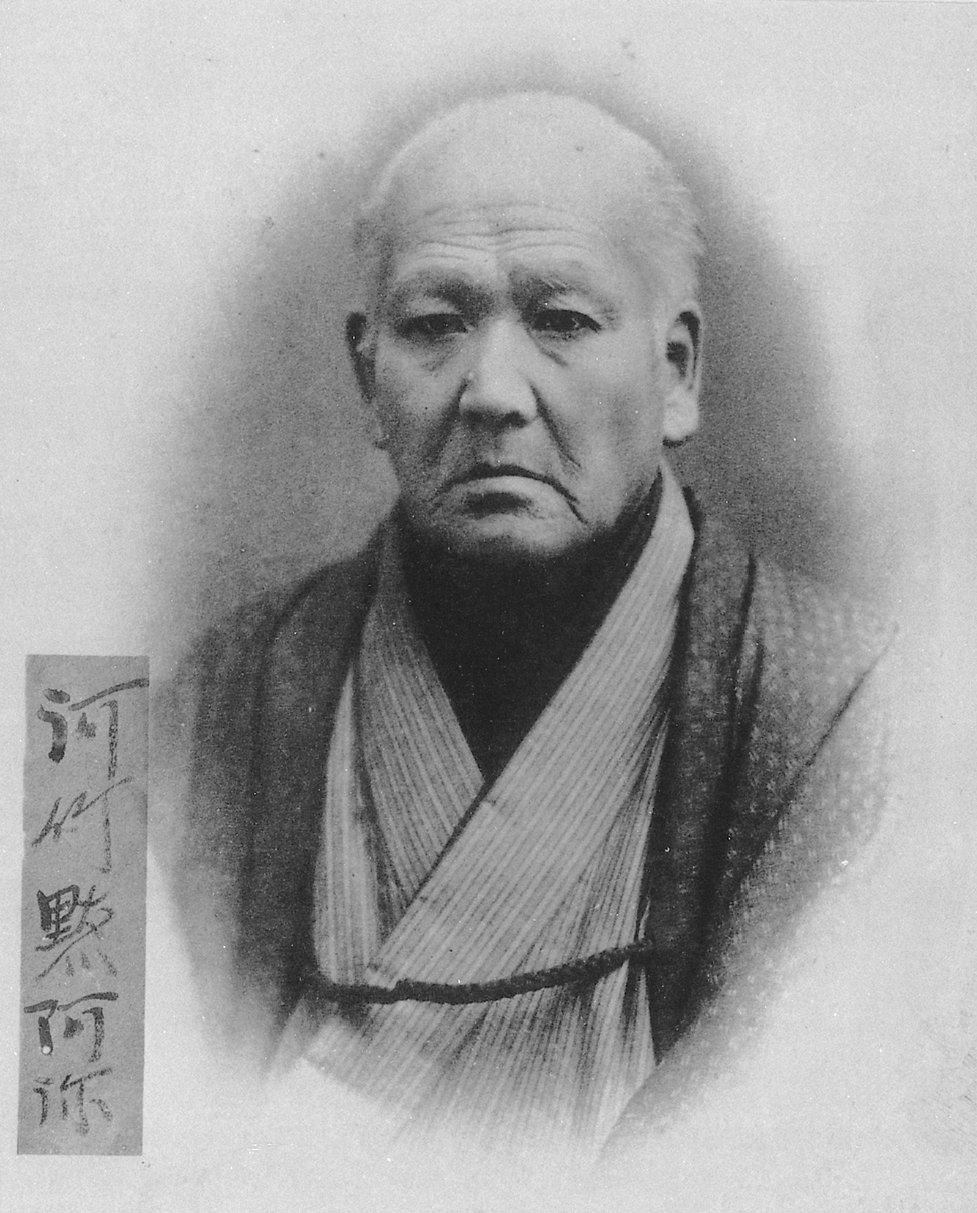
Kawatake Mokuami
A kabuki playwright active from the final years of the Tokugawa period to the early Meiji period. He was extremely prolific, having written about 360 works
1816-1893
Kawatake Mokuami was a kabuki playwright of the end of the Tokugawa period and the early Meiji period. He was originally named Yoshimura Yoshisaburo, and his pen name for haiku was Kisui. He was born into a merchant family of Nihonbashi, Edo. After passing through a period of dissipation in his youth, he began studying under Tsuruya Nanboku V, and in 1835 he assumed the name Katsu Genzo I and began working under the playwrights of Ichimura-za, a major theater in Edo. In 1843 he adopted the name Kawatake Shinshichi II and became the head playwright for the theater. In 1854 he wrote Miyakodori nagare no shiranami (The Great Thief of the Miyakodori Brothel), commonly known as Shinobu no Sota (The Furtive Sota), at the request of the actor Ichikawa Kodanji IV. This play, while at first not doing well, later sold out to packed houses. Following up on this success, Mokuami wrote, and Kodanji acted, a large number of kabuki plays about thieves, including Nezumi komon haru no shingata (The New Look of the Thief Nezumi Kozo in Spring), commonly called Nezumi Kozo, and Sannin Kichisa kuruwa no hatsugai (The Three Kichisaburos Make Their First Purchase of the Year in the Pleasure Quarters), popularly known as Sannin Kichisa (The Three Kichisaburos). These plays reflected the foreboding that permeated society toward the end of the Edo period. The two men came to be called "the thief actor" and "the thief playwright," and Mokuami busily wrote plays for all three major Edo theaters (Nakamura-za, Ichimura-za, and Morita-za). After Kodanji died, his son Ichikawa Sadanji I often filled in for him.
Mokuami left behind many works. There are sewamono (plays about contemporary life and manners), his specialty; katsurekimono (realistic historical dramas), which he wrote for Ichikawa Danjuro IX; and zangirimono (plays describing the modernization and Westernization of early Meiji society), which he wrote for Onoe Kikugoro V. He thus contributed greatly to the repertoire of Edo kabuki. In 1881 he changed his name to Mokuami and announced his retirement, but he continued to remain active in an auxiliary capacity. His total output reached 360 works, and he was particularly noted for the five- and seven-syllable metered lines that he gave to actors in his plays. His most celebrated works, in addition to those mentioned above, include Utamomiji Utsunoya toge (The Maple Leaves at Utsunoya Mountain Pass), Kosode Soga azami no ironui (a play about the robber Onibozu Seikichi), Aoto Zoshi hana no nishiki-e (a tale about a band of five thieves), Tsuyu kosode mukashi hachijo (a play about a crooked hairdresser, Shinza), Kumo ni mago Ueno no hatsuhana (The First Flowers of Ueno, about the gang boss Kochiyama in the disguise of a priest), Shima chidori tsuki no shiranami (Island Plovers and Moonlit Frothy Waves, a metaphor meaning, The Gay Quarter Dancer and the Thief), and Takatoki (Regent Hojo Takatoki). For his apprentices he wrote the book Kyogen sakusha kokoroe (Principles for Writers of Kabuki Plays).
Related People, Things and Events
Books
Theatrical playbooks
Biographies and critical biographies
Related Works
Playbills
黙阿弥脚本上演の記録
Mokuami's Kyogen in nishiki-e (colored woodblock prints)
Kyogen plays that star Kodanji Ichikawa IV
Sannin Kichisa Kuruwa no Hatsugai (“Three Kichisaburos Go Shopping at the New Year in the Pleasure Quarters”), or Sannin Kichisa
Aoto Zoshi Hana no Nishiki-e (“The Story of Aoto and the Gorgeous Woodblock Print”), or Shiranami Gonin Otoko (“Five Men of the White Waves”)
Kumo ni Magou Ueno no Hatsuhana: Kochiyama to Nao-Zamurai (“Ueno’s First Cherry Blossoms Mistaken for Clouds: Tea Master Kochiyama and the Faithful Samurai”)
Other works
External Links
The National Diet Library (NDL), founded in 1948, is the library which belongs to the Diet. The NDL assists the activities of the National Diet. The Library collects and conserves materials and information both from Japan and abroad, serving as a foundation of knowledge and culture and providing library services to administrative and judicial entities and Japanese citizens.
With the aid of supporters from a range of fields, The Tsubouchi Memorial Theatre Museum, Waseda University, familiarly known as "Enpaku", was founded in October 1928 to commemorate the 70th birthday of Professor Tsubouchi Shoyo and the completion by him of the translation into Japanese of all 40 volumes of the "Complete Works of Shakespeare", a task to which the Professor had devoted half his life. Since then, as Asia's only museum dedicated solely to the theatre, Enpaku has been engaged in collecting works relating to the theatre and motion pictures both in Japan and all around the world. Its extensive collection of about one million works that has been amassed over 85 years may be termed as "the history of theatre" itself. Meanwhile it also contributes to researchers from a wide range of fields, extending from the theatre and motion pictures to other areas such as literature, history, clothing and construction.
東京都台東区にある。東京とりっぷサイト。
東京都中野区の源通寺に河竹黙阿弥の墓がある。中野区公式観光サイト。
国立国会図書館
伝統芸能の保存及び振興を行う独立行政法人日本芸術文化振興会が運営するサイト。河竹黙阿弥の生涯や関係する人々、主な演目などを紹介している。
「河竹黙阿弥」関連の演目情報・資料情報・人物情報を調べることができる。演目情報では出演者やスタッフなども載せている。
上演のつど発行される。「三人吉三巴白浪」「天衣紛上野初花」「新皿屋舗月雨暈」の上演年表を見ることができる。
歌舞伎 on the web
早稲田大学図書館が所蔵する古典籍の書誌情報と関連研究資料、さらには全文の画像を、学術研究に資する目的で広く全世界に公開するもの
References
- 服部幸雄, 富田鉄之助, 廣末保 編,平凡社膨大な専門知識の蓄積を系統的に集大成した初の本格的専門事典。最新の研究成果を織り込み,伝承技術と知識と1500余項目で解説。(日本児童図書出版協会)