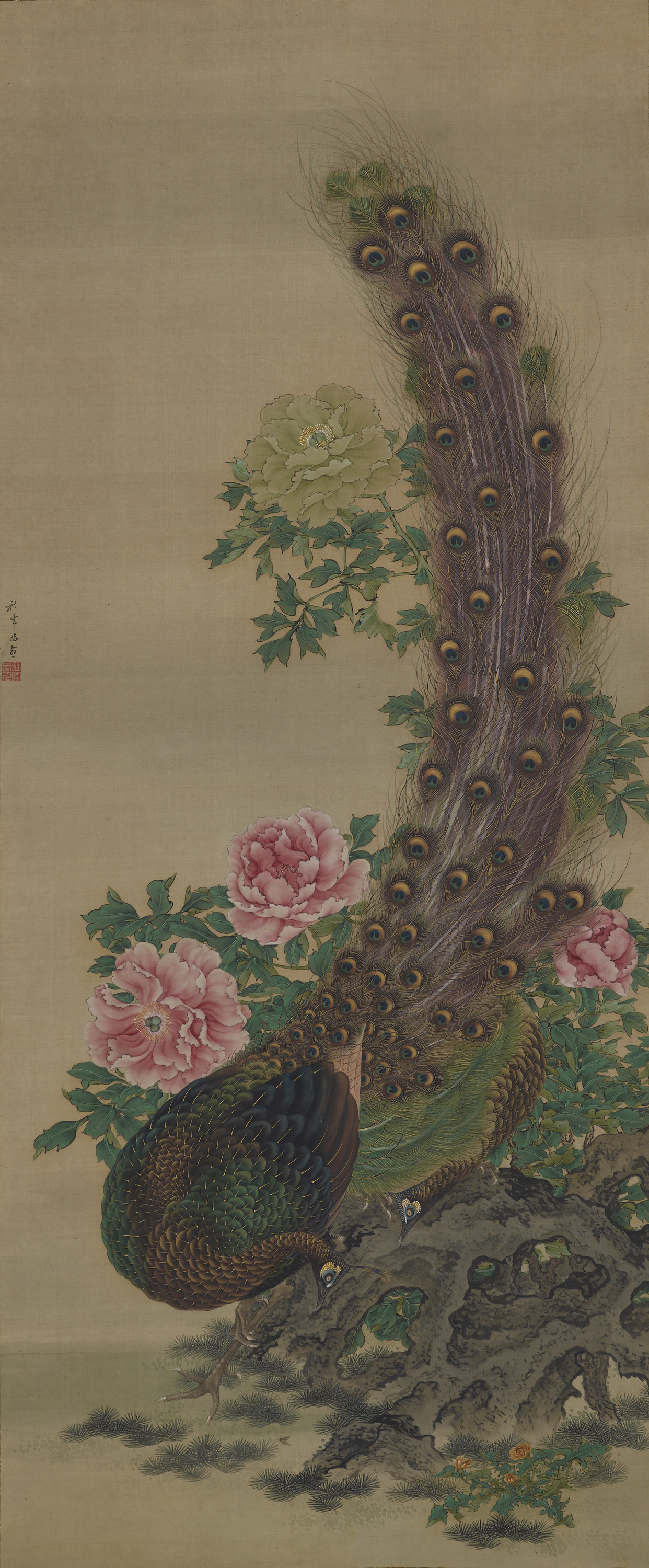
Peacock (Kujaku)
The Indian peafowl, distributed in South Asia, and the green peafowl, distributed from Southeast Asia to China; their brilliant feathers are prized for their beauty
Taxonomically, the term "peacock" refers to three species of birds in two genera of Phasianidae (Pavo and Congo peafowl), but here it refers to two species of the genus Pavo (Indian peafowl and green peafowl), distributed in Asia.
Neither of these species is native to Japan, but the Indian peafowl, which is naturally distributed in South Asia (India, Sri Lanka, eastern Pakistan, and western Bangladesh) has been designated as an alien species in Japan under the Basic Policy for Preventing Adverse Effects on Ecosystems Caused by Invasive Alien Species, because Indian peafowl introduced as pets have escaped in various places and breed outdoors. They have been exterminated in some of Japan's southwestern islands. The green peafowl, distributed from Southeast Asia to China (Cambodia, Thailand, Vietnam, Myanmar, Indonesia, Malaysia, and China), is said to be the largest and most beautiful pheasant. Since it is highly aggressive during the breeding season, it is more often seen at zoos than as a pet. However, its population has decreased even in its place of origin, and many green peafowl are hybrids between subspecies of green peafowl or hybrids with Indian peafowl, and pure green peafowl are becoming rare.
The splendid tail feathers of the peacock are prized for their beauty. Indian peafowl have been bred in the West since ancient times. It is said that Alexander the Great brought them back from India. On the other hand, the green peafowl became known to the West only in the sixteenth century. After the green peafowl was drawn in a screen painting given to Pope Gregory XIII by the Tensho Embassy, it was described as a new species in Ulisse Aldrovandi's Ornithologiae (Ornithology, 1599-1634). John Jonston described the green peafowl in his Historiae naturalis de avibus (Natural History of Birds), and Carl Linnaeus gave the name of "Japanese Peacock" to Pavo muticus. In other words, until the eighteenth century, Europeans believed in the existence of green peafowl with only one picture, and they believed this bird to be Japanese.
Nihon shoki (Chronicles of Japan, 720) records that the first peacock brought to Japan was a bird that Silla presented to Japan in 598. After that, there are many records of peacocks (probably green peafowl) coming to Japan via the Korean Peninsula and Japanese envoys to Tang China.
Mahamayuri is a single-faced four-armed Indian deity who sits on the back of a peacock. Originally a peacock herself, this peacock queen of wisdom protects against poisonous snakes by eating them. In India, the peacock on which Mahamayuri sits is presumably an Indian peacock, but the peacocks in images transmitted via China to Japan are usually green peacocks. An example is the national treasure Kenpon chakushoku Kujaku Myoo zo (Color on Silk Painting of Mahamayuri).
In the Edo period (1603-1867), peacocks became a display item. One can see such peafowl in the screen painting Shijogawara yugaku zu (The Shijogawara Entertainment District) of the Kan'ei era (1624-1644). During the Kansei era (1789-1801), peacock teahouses began to keep peacocks to attract customers. These later became flower and bird teahouses, which in turn were the forerunners of modern zoos.
Related Galleries
Books
Literary works that feature peacocks
Related Works
Videos
「青い目の見た大正時代の日本」は、1917年~18年(大正6~7年)に撮影された日本各地の記録映像で、米国のスミソニアン博物館とNHKが保管しています。円山公園の満開の桜のもと、談笑しながら歩く女学生の列、公園の孔雀、ブランコを撮影した映像です。
正式名称「松島青龍山瑞巌円福禅寺」本堂・御成玄関、庫裡・回廊は国宝に、御成門・中門・太鼓塀は国の重要文化財に指定されています。本堂は修復され、平成28年4月に拝観が再開されました。中門・御成門などの修復は平成29年11月まで続きます。\n\n(この動画は、2011年に放送したものです。) 本堂には孔雀の間がある。
Institutions Holding Related Materials
福岡県久留米市に所在。鳥類を74種飼育する。ホームページ内にクジャクのライブカメラあり。
The National Diet Library (NDL), founded in 1948, is the library which belongs to the Diet. The NDL assists the activities of the National Diet. The Library collects and conserves materials and information both from Japan and abroad, serving as a foundation of knowledge and culture and providing library services to administrative and judicial entities and Japanese citizens.
As Japan’s representative museum, Tokyo National Museum collects, preserves, displays, and researches the cultural properties of Asia with a focus on Japan, and also provides educational programs.
Kyoto National Museum collects, preserves, displays, researches and provides educational programs focusing on cultural properties from Heian- through to Edo- period Japan, when the capital was located there.
Established in 1877, the National Museum of Nature and Science (Kahaku) is one of the oldest museums in Japan. It is also the only national museum in the country that offers a comprehensive exhibition of natural history and the history of science and technology. It collects and preserves a variety of collections, such as natural history specimens, historical objects, and scientific and technical documents, and so on.
External Links
日本に定着している外来種に関するデータベース。インドクジャクに関するデータが記載されている。
公益財団法人東京動物園協会運営のサイト。動物の写真、鳴き声、飼育園館などがまとめられている。
東京都中央区京橋にあるアーティゾン美術館のコレクションデータベース。円山応挙画「牡丹孔雀図屛風」を見ることができる。
神奈川県足柄下郡箱根町にある私設美術館の収蔵品データベース。伊藤若冲画「孔雀鳳凰図」を見ることができる。
References
- 日立デジタル平凡社,平凡社
- 狩野博幸 監修,河出書房新社
- 今橋理子 [著],講談社