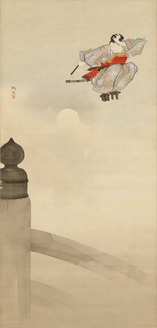
Minamoto no Yoshitsune
A tragic military commander featured in a host of legends and associated with sympathetic treatment of inferiors
1159-1189
Minamoto no Yoshitsune was a military commander from of the late Heian period (1156-1185) to and early Kamakura periods (1185-1235). He was the ninth son of Minamoto no Yoshitomo, and his mother was Tokiwa Gozen. His childhood name was Ushiwaka, and he was also called Kuro and Shanao. Yoritomo Minamoto no Yoritomo, who founded the Kamakura shogunate, was his older paternal half-brother. Captured along with his father Yoshitomo and others In the Heiji Rebellion of that occurred in 1159, it is said, he was captured, along with his father Yoshitomo and others, and held at Ushiwaka is said to have entered Kyoto's Kurama-dera Temple in Kyoto. Subsequently, he reportedly escaped to Mutsu Province, where he was raised under the protection of Fujiwara no Hidehira in Hiraizumi (present-day Hiraizumi-cho, Nishiiwai District, Iwate Prefecture).
It was Not until later, however, can we verify that actions of Yoshitsune's actions can be verified as a matter of historical fact. This began when he left Hiraizumi, Upon hearing that Yoritomo had raised an army to seek out and destroy the Taira clan, and he left Hiraizumi and joined his Yoritomo's forces in Suruga Province's Kisegawa, Suruga Province (today's Numazu, Shizuoka Prefecture), where he met face to face with Yoritomo. In January 1184, Yoritomo entrusted the forces to Yoshitsune and his younger brother Noriyori and sent them westward, where they defeated Yoshinaka Minamoto no Yoshinaka, Lord Kiso, (Yoshinaka Kiso) at the Battle of Ujigawa. In February of the same year, Yoshitsune and Noriyori's forces attacked the Taira in Settsu Province's Fukuhara, Settsu Province (now Hyogo-ku Ward, Kobe, Hyogo Prefecture), and triumphed at the Battle of Ichi-no-tani on account of a surprise attack by Yoshitsune at Hiyodorigoe. In February of 1185, Yoshitsune made a sea crossing to attack the Taira clan at Yashima, Sanuki Province (now Takamatsu, Kagawa Prefecture), in Sanuki Province at the Battle of Yashima. Though While the Taira clan made an escape to Hikoshima, Nagato (now Shimonoseki, Yamaguchi Prefecture) in Nagato Province, the following month they were destroyed after being defeated in the Battle of Dan-no-ura and thereby destroyed. the following month. The sequence of events These feats led overnight to Yoshitsune to being regarded as a hero overnight. He also came to be despised by Yoritomo, who thought that Yoshitsune had gotten too close to the cloistered (retired) emperor Go-Shirakawa, among other things. Though Yoshitsune sent his "Koshigoe letter" to Yoritomo in an attempt to explain himself, he was reportedly not allowed entry into Kamakura. At this point Though he again turned to Hidehira Fujiwara Hidehira for his protection, but following Hidehira's death, once again, Hidehira's son Yasuhira yielded to Yoritomo's demands and following Hidehira's death and made an attack on attacked him at Takadachi in Hiraizumi on the 30th of the intercalary Fourth Month day of April in in the intercalary year of 1189, forcing Yoshitsune to commit suicide to avoid capture. Yoshitune was accordingly made to commit suicide.
There are many legends involving Yoshitsune., He reputedly fought including that he competed in martial arts with a small tengu (mischievous spirit) at Kuramadera Temple in a display of martial skills. Other well-known tales include his duel He fought with Benkei on the Gojo Bridge in Kyoto. At Yashima he had the boats row backwards to confront Kajiwara Kagetoki., his confrontation with Kagetoki Kajiwara concerning "reverse oars" during the attack on Yashima, and his leap At Dannoura he leaped over eight boats at Dan-no-ura. In the Edo Period (1603-1868), there appeared a further the theory that he traveled to Ezogashima (Hokkaido) and became a king there, and in the Meiji Era Period (1868-1912) a the story spread that he made his way to mainland Asia to become Genghis Khan. Yoshitsune is also featured in the kabuki plays Also featured in kabuki plays such as Yoshitsune senbon zakura ("Yoshitsune and the Thousand Cherry Trees") and Kanjincho ("The Donation Subscription BookList")., A tragic hero, Yoshitsune came to elicit feelings of sympathy as a tragic hero, a sentiment known as hogan-biiki, in reference referring to his title of kuro hogan (magistrate of the ninth grade). This term later developed the, a term that also covers an extended meaning of sympathetic support for the underdog. disadvantaged or defeated parties. Yoshitsune's association with this term has helped to keep his memory alive in the public imagination. remains a figure with which many people are still affectionately acquainted today.
Related People, Things and Events
Books
Edo period (1603-1868) works
Other items
Related Works
Yoshitsune and Ushiwaka (his child name) in ukiyo-e paintings
Depictions of Yoshitsune in yakusha-e (portraits of actors)
Dolls, netsuke (carved Japanese ornament), etc.
Yoritomo Minamoto's favorite concubine, Shizuka Gozen
The Genpei War
Videos
Search by map
Past Exhibitions
| Title | shusai | Place | open | close |
|---|---|---|---|---|
Institutions Holding Related Materials
鞍馬寺のHP。京都市左京区鞍馬本町にある寺院で、若き日の牛若丸(源義経)が入山したといわれています。
岩手県西磐井郡平泉町の平泉観光協会が運営するサイト。「世界遺産 平泉」のほか「歴史と文学」などのページがあり、源義経の最期の地とされる奥州平泉について紹介しています。牛若丸時代の義経は、鞍馬寺から出て平泉の藤原秀衡を頼り、晩年には再び秀衡を頼りましたが、平泉の地で非業の死を遂げました。
香川県観光協会が運営するサイト「うどん県旅ネット」より。源平合戦の「屋島の戦い」の舞台は、香川県高松市に所在しています。
山口県下関市みもすそ町に所在。ブログ「平家物語・義経伝説の史跡を巡る」より。豊富な写真などが掲載されています。
神奈川県鎌倉市腰越に所在。義経ゆかりの寺で、鎌倉に入る許可を得るため、義経は頼朝に対して「腰越状」を書いています。
岩手県西磐井郡平泉町平泉に所在。文治5年(1189)閏4月30日、義経は弁慶ら主従とともに藤原秀衡の子、泰衡の急襲にあい、この地で自害したと伝えられています。
青森県東津軽郡外ヶ浜町三厩家ノ上(みんまやいえのうえ)に所在する寺院。奥州平泉で生き延びた義経一行は、この地から津軽海峡を越えて蝦夷地(北海道)へ渡ったと伝えられています(青森県及び公益社団法人青森県観光連盟が運営する「Amazing AOMORI」より)。
北海道平取(びらとり)町本町に所在する神社。義経伝説の一つとして、奥州平泉で生き延びた義経が紆余曲折を経てこの地に辿りつき、アイヌと互いの文化を共有したといわれています。
全国各地に存在する義経(牛若丸、遮那王)に関わる史蹟を、画像とともにいろいろな視点から紹介しています。
有限会社アップ・トゥ・カンパニーが運営するサイト「e京都ねっと」より。義経の京都での足跡について、「洛中編」と「鞍馬編」に分けて紹介しています。また、「義経の詳しいプロフィール」も載っています。
岩手県県北広域振興局・岩手県沿岸広域振興局が制作したサイト。義経北行伝説について、岩手県を中心に紹介しています。
岩手県の平泉町世界遺産推進室が運営するサイト「平泉 平泉の文化遺産」より。中尊寺金色院所蔵の義経像(安土・桃山時代)の画像が掲載されている。サイトでは、世界文化遺産としての平泉の解説がなされている。
「鎌倉手帳(寺社散策)」より。義経の生涯が年表形式で紹介されており、義経に関わる旧跡などの画像も見ることができる。
NHK for School「歴史にドッキリ」より。
さまざまな文献に見える義経の画像を紹介している。
アジア・太平洋総合研究センターが運営するサイト「Science Portal Asia Pacific」(サイエンスポータルアジアパシフィック)のコラム&リポート「文化の交差点」より。
歌舞伎演目案内(歌舞伎 on the web事務局が運営する歌舞伎公式HP「歌舞伎 on the web」)より。作品のあらすじや概要、登場人物などを紹介している。
歌舞伎演目案内(「歌舞伎 on the web」)より。作品のあらすじや概要、登場人物などを紹介している。
「文化デジタルライブラリー」より。「早わかり」「背景を知る」「ひもとく」「よもやま」の各章で構成され、丁寧な解説がなされている。
本書は江戸時代中頃の写し。柔術の世界には、源義経を始祖とする流派がある。牛若時代に、鞍馬山で武芸を習ったといわれることに由来するらしいが、江戸時代には武芸の祖として義経が敬われていたとされる。
References
- サンプルページ「源義経」の項
- 「源義経」の項
- 「源頼朝」の項
- 渡辺保 著,吉川弘文館
- 上横手雅敬 著,平凡社
- 元木泰雄 著,吉川弘文館
- 保立道久 著,日本放送出版協会
- 竹内理三 著,中央公論新社
- 歴史学研究会 編,岩波書店
- サンプルページ「平家物語」の項
- サンプルページ「義経記」の項
- サンプルページ「義経千本桜」の項
- 『義経記』が載っている。
- 黒板勝美 編,国史大系刊行会
- 五味文彦, 本郷和人 編,吉川弘文館
- 五味文彦, 本郷和人 編,吉川弘文館
- 五味文彦, 本郷和人 編,吉川弘文館
- 五味文彦, 本郷和人 編,吉川弘文館