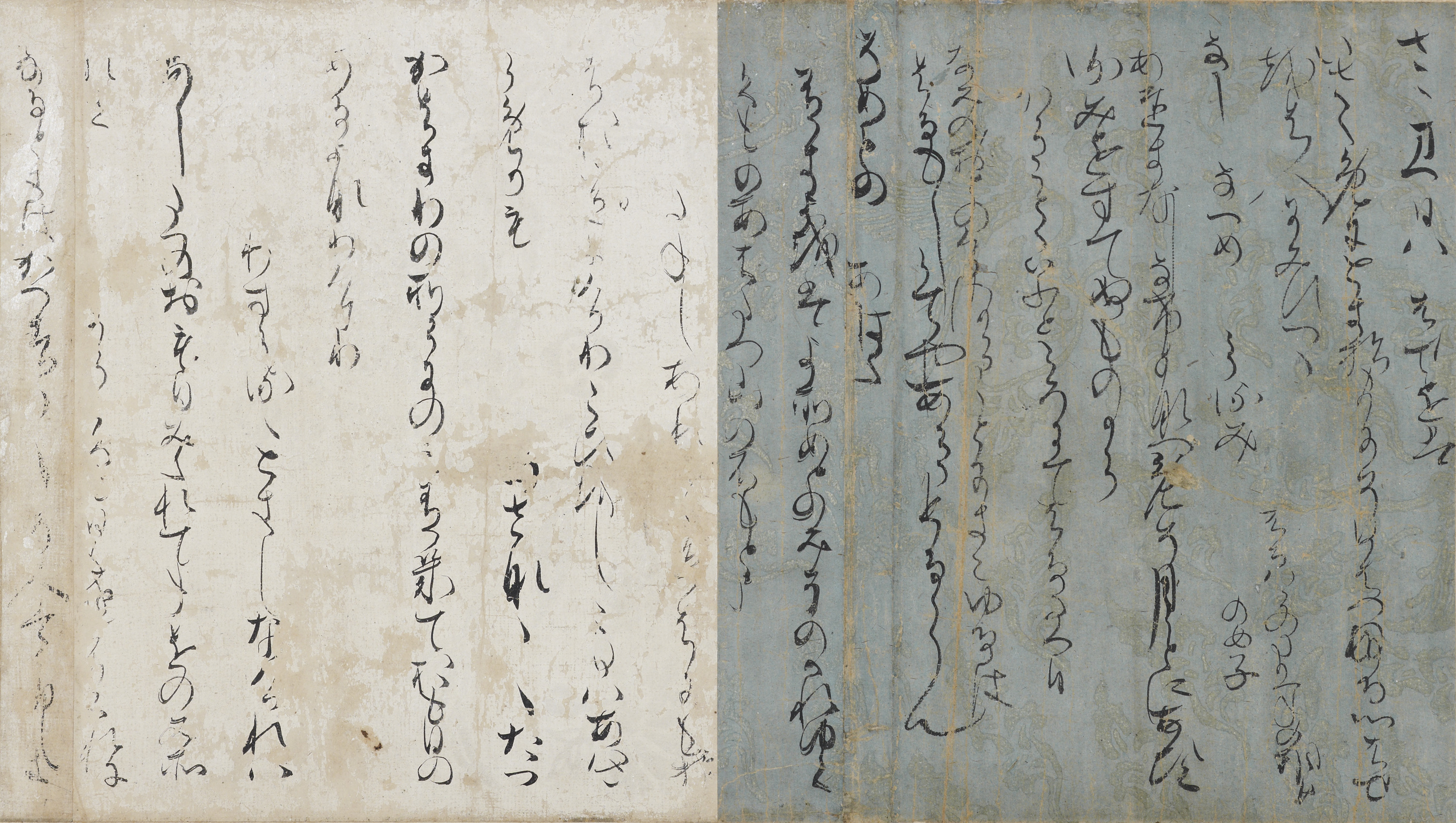
Japanese calligraphy
A type of written art that originated in China and was nurtured and developed in the context of Japanese culture
Table of Contents
From ancient times through the present, Japanese calligraphy has developed as artists assimilated the Chinese calligraphy methods of various eras, and also explored and created original Japanese calligraphy formats attuned to the unique Japanese culture and aesthetic sense. For this reason, Japanese calligraphy is divided into two major styles: a Chinese style that uses only Chinese characters, and a Japanese style that diverged from the Chinese style during the Heian period (794–1185) and developed independently.
The history of Japanese calligraphy begins with the introduction of characters from China. The oldest historical relic featuring written text is the King of Na gold seal bestowed by Emperor Guangwu of the later Han Dynasty (c. 25–220) to the King of the Na state (Japan) in the mid-first century. Mirrors and swords engraved in Japanese with Chinese characters have been excavated from kofun burial mounds that date back to the mid-fifth through the sixth century, which suggests that in that period the utilization of Chinese characters in Japan had already advanced.
During the Asuka period (592–710), Buddhism was introduced to Japan from continental Asia, and numerous Buddhist scriptures were brought to Japan, together with techniques for making ink, paper, and brushes. Moreover, during the Nara period (710–794), copying of sutras gained popularity, offices for copying of sutras were established at government institutions, and large-scale sutra copying projects were undertaken with the goal of protecting the nation.
The Heian period (794–1185) is known as an era with a focus on fostering Kokufu-bunka (native Japanese culture). It was a turning point from a linguistic perspective as well, because of the creation of kana, a phonetic script that is well-suited for graphically representing the Japanese language. The formation of the kana script also led to the birth and establishment of a new, Japanese style of calligraphy, which was different in touch and taste from the Chinese style that until then had served as the model.
Calligraphy of the Heian period (794-1185)
日本風の書風「和様」の書の誕生と確立
平安時代初期は、奈良時代に引き続き、朝廷が遣唐使を派遣し、唐文化の積極的な摂取が行っていた。この時代を代表する能筆として、今日「三筆」と称され、日本の書の基盤を築いた、空海・橘逸勢・嵯峨天皇が挙げられる。現在、橘逸勢の確実な真筆は確認されていないが、空海、そして空海に書を学んだ嵯峨天皇の書からは、唐風の書、特に、中国で「書聖」と呼ばれた東晋時代の能筆・王羲之の影響を見ることができる。平安時代中期に遣唐使が廃止され、大陸との国交が途絶えると、日本の風土や日本人の嗜好に叶った国風文化が育まれるようになる。漢字を簡略化した、平仮名(女手)が急速に発達。日本固有の詩歌である和歌が隆盛し、初の勅撰和歌集『古今和歌集』が成立する。この時代に活躍したのが小野道風、藤原佐理、藤原行成の「三蹟」である。この3人の手によって、日本風の流麗な和様の書が完成し、以後、日本の書は和様の書を中心に展開する。11世紀半ばには、仮名書の最高水準として古来より名高い「高野切本古今和歌集」が生まれ、以後、「古筆」として珍重される仮名の名品が次々と出現した。
Calligraphy of the Kamakura period (1185-1333) and the Nanboku-cho period (1337-1392)
流儀書道の盛行と墨蹟の影響
鎌倉時代は、流儀書道(書流)が確立されていった時代である。鎌倉時代に盛行した代表的な流派に、「三蹟」の一人、藤原行成を始祖とする「世尊寺流」や、平安末期の関白、藤原忠通が創始した「法性寺流」などが挙げられる。忠通の法性寺流は、伝統的な和様の書に力強さを加えた書風で、武家文化が台頭する世情に合致し、鎌倉時代に貴族や武士の間で大きな流行をみせた。また、鎌倉時代には大陸との交流が復活し、中国から禅宗とともに禅宗僧侶の書「墨蹟」がもたらされた。墨蹟は、禅僧を中心に日本の書に大きな影響を与え、その影響は皇室にも及んだ。この時代、歴代の天皇によって、和様の書風や宋・元の書を踏まえた格調高い書が多く遺されており、それらは「宸翰」と呼ばれている。続く南北朝時代には、青蓮院の門跡・尊円親王が青蓮院流を創始する。尊円親王は、世尊寺流の書を学んだ後、上代様の書、さらに宋の書風をも取り入れて独自の書風「青蓮院流」を完成。以後、この青蓮院流は日本の書の主流となった。
Calligraphy of the Muromachi period (1336-1573) and the Azuchi-Momoyama period (1573-1603)
戦乱の時代の書
戦乱が続いた室町時代から安土桃山時代は、日本の書が停滞し、定型化した時期であったといわれるが、動乱の最中にも、歌人・飛鳥井雅親、後柏原天皇ら能書による新しい流派が生まれるなど、書の潮流が絶えることはなかった。この乱世の時代を代表する書家の一人に、室町時代中期の臨済宗の僧・一休宗純がいる。当時の禅宗の形骸化を厳しく批判した一休の書は、日本風と中国風の書法を融合しながらも、その反骨精神を反映した極めて個性的な書で、近世禅僧の書の先駆となった。わび茶の祖として知られる村田珠光は、この一休宗純から受け取った宋の禅僧・圜悟克勤の墨蹟を床の間に掛けたといわれ、これが茶席における墨蹟使用のはじまりであったと伝わる。室町時代から安土桃山時代にかけて大成された茶の湯の世界では、茶席の床の間に書を飾るという慣習ができ、中でも禅僧の墨蹟や古筆切は古来珍重された。これらの名品は茶席の掛物として愛好され、数々の茶人たちの手を経て、今日に受け継がれている。
Calligraphy of the Edo period (1603-1868)
幕府の公用書体「御家流」と唐様の流行
江戸時代に入ると、「寛永の三筆」といわれる本阿弥光悦・近衛信尹・松花堂昭乗が活躍した。彼らは中世の流儀書道の源流である平安時代の古筆を基調にしながらも、自らの斬新な表現に挑戦し、定型化していた日本の書に新風を吹き込んだ。また、尊円親王に端を発する青蓮院流の書体が江戸幕府の公用書体「御家流」として採用され、これが広く庶民にまで浸透し、寺子屋教育の隆盛や識字率の向上をもたらす。一方で、幕府の儒学奨励策や、17世紀半ばに、明から黄檗宗(禅宗の一派)がもたらされたことによって、新様式の中国書法「唐様」の書が流行。初期は儒者や漢学者などに限定されていた唐様であったが、徐々に裾野を広げ、幕末には御家流を凌ぐまでとなった。このような和様と唐様の二つの潮流のはざまで、松尾芭蕉・与謝蕪村・池大雅・良寛など、文人や僧侶による個性豊かな書も生み出されている。
References
- 『日本書道史年表』名児耶明 編,二玄社
- 『説き語り日本書史』石川九楊 著,新潮社
- 『別冊太陽 日本の書ー古代から江戸時代までー』名児耶明 監修,平凡社
- 『すぐわかる日本の書 : 飛鳥時代~昭和初期の名筆』可成屋 編,東京美術
- 『世界大百科事典』(japanknowledge)
- 『日本大百科全書』(japanknowledge)
- 『国史大事典』(japanknowledge)
- マルチメディアマイペディア 百科事典CD-ROM日立デジタル平凡社,平凡社
- JapanKnowledge・コトバンク所収コンテンツの最終アクセス日は、いずれも2021/12/20。