Grape
A deciduous vine plant of the Vitaceae family. As well as being eaten raw, the fruits are used to make wine.
A deciduous vine plant of the Vitaceae family. Grows tendrils and twists around other things. Leaves are simple, alternate, often divided. Produces clusters of many small flowers during May-June. Flower petals are green and fused at the top. Flowers fall off as a hat might slip off one’s head after blossoming. Ripening around August to October, fruits are fleshy and have various sizes, shapes, and skin colors depending on the variety. Over 50 principal species exist, distributed mainly in Central Asia, East Asia, and North America. Wild species grow in Japan as well, including yamabudo (crimson glory vine, Vitis coignetiae), ebizuru (V. ficifolia), and sankakuzuru (V. flexuosa). Older names in Japanese include ooebikatsura, ebikatsura, and ebi.
Its history of cultivation is long, with depictions of grape harvests and winemaking appearing on ancient Egyptian frescoes as early as 15th century BC. European wine varieties reached Japan by way of China, and viniculture came to be more widespread with the establishment of an original Japanese trellis-making technique at the beginning of the Genna era (1615–1624). In the mid-Edo Period (c.1700–1750), the Koshu-budo, or Koshu grape variety, from Kai Province (present-day Yamanashi Prefecture) was known in Edo. During the Meiji Period (1868–1912), cultivar improvement advanced further, and Japanese wine production began in earnest.
In the West, grapes symbolize bountiful harvests and have also been considered sacred fruits, with Greek mythology including a god of wine, Dionysus (in Roman mythology, Bacchus). In Christianity, wine represents the blood of Jesus Christ. Grape arabesque patterns featuring the leaves, vines, and fruits of the grape as motifs are thought to have originated in ancient Assyria (corresponding to modern-day northern Iraq), and they spread to the East from Greece, Rome, and Persia via the Silk Road. In Japan, they were used as designs considered to have an exotic flavor.
Related People, Things and Events
A tall deciduous tree in the family Ebenaceae, cultivated since ancient times for a variety of uses, including its edible fruit; long a part of the Japanese lifestyle
A deciduous tree of the Rosaceae family, appreciated in Japan for its delicious fruit and lovely blossoms used as decorations for spring festivals
Along with cherry blossoms, Japanese plum flowers have been familiar to Japanese people since ancient times
A plant familiar in Japan that lends its name to yamabuki-iro, the traditional Japanese color of golden yellow
A shrub with red or white flowers from spring to summer
A major flowering tree native to Japan in the Theaceae family, known in Europe as “winter’s rose”
Asagao is an annual of the Convolvulaceae Morning Glory family. It was a popular flower for gardening, and exhibitions were held frequently.
An aquatic plant of the Nelumbonaceae family, familiar in Japan through its associations with Buddhist sutras and its edible root
Books
岩崎常正,写
『本草図譜』から「葡萄」の図。『本草図譜』は江戸時代の代表的な植物図譜で、筆者岩崎灌園(常正、1786 - 1842)の実見した本草約2000種を写生・彩色して、山草・湿草・毒草などに分類したもの。全96巻のうち、文政13年(1830)に巻5から巻10までの6冊が出版されたが、印刷・刊行されたのはこの6冊のみで、以後は灌園の原本を画家に模写させて予約者に配布するかたちで続けられた。掲載の図は、国立国会図書館が所蔵する田安家旧蔵本のうちの1冊から。田安家旧蔵本は、『本草図譜』としては稀な完本で、優れた画家に模写させたと思われる良質な図が多いことで知られている。
岩崎常正,写
『本草図譜』から「水晶葡萄」「瑣瑣葡萄」の図。
岩崎常正,写
『本草図譜』から「蘡薁(エビヅル)」の図。
岩崎常正,写
『本草図譜』から「のぶどう(蛇葡萄)」の図。
深江輔仁 奉勅新撰,多紀元簡 [校],和泉屋庄次郎
『本草和名』より「蒲萄」の項。和名は「於保衣比加都良(オオエビカズラ)」とある。 『本草和名』は『新修本草』所収品の漢名-和名辞書で、深江輔仁(すけひと、生没年未詳)が勅を奉じて延喜18年(918)頃に作成した。すでに散逸した古書からの引用が多いことでも知られる。『本草和名』は長いあいだ存否不明の書だったが、寛政6年(1794)に幕医多紀元簡(もとやす、のち幕府医学館主)が幕府の紅葉山文庫で古写本を発見、それを校訂して刊行した。本資料は、考証学者小島尚質(なおかた)・尚真(なおざね)父子の旧蔵書で、諸書を用いて父子がさらに校注を進めたものである。一方、刊行に関連する多紀家の記録も写しており、それによって元簡が幕府の出版許可を得るために提出した文書が判明するし、「享和二年[1802]壬戌秋八月廿七日初刷装釘」とあって、出版年が通説の寛政8年(1796)ではないことも明らかになる(『江戸出版書目』によると、出版・販売の許可を得たのは寛政12年12月)。なお、『日本古典全集』に所収されている森立之・約之父子旧蔵『本草和名』刊本への書き込みは、上記多紀家記録を含め、本資料の小島父子書き入れの転写が少なくない。本書刊本には、初版と後刷の2種類がある。初版―表紙は朱色/上巻見返しに出版事項は無し/下巻末尾、「江戸浅草新寺町・和泉屋庄次郎発行」:小島氏本(本書)、121-37本など後刷―表紙は藍色/上巻見返しに出版事項(書名・著者名など)/下巻末尾、「三都発行書林」として9軒の書肆名:特1-218本、『日本古典全集』森氏旧蔵本(磯野直秀)
[中村[テキ]斎] [編],山形屋
『訓蒙図彙』には「葡萄 えび 俗音ぶだう」とある。『訓蒙図彙』は江戸時代の図解事典。20巻。中村惕斎(てきさい)著。寛文6年(1666)成立。天文・地理・動植物などについての精確な図に和名・漢名・注記を付した啓蒙書。
丹岳野必大千里 著
江戸時代の食物書『本朝食鑑』。葡萄について、「昔は恵比(えび)と訓んだ」とある。「甲州に最も多く、駿洲が次ぐ」とも。『本朝食鑑』は医師の人見必大 (ひとみひつだい) が著した書で、魚介類など庶民の日常食糧を取材した見聞にもとづき解説している。元禄8年(1695)刊行。
宮崎安貞 著,貝原楽軒 補,貝原益軒,山中善兵衛[ほか4名]
『農業全書』は江戸中期の農学者・宮崎安貞(1623-1697)による農学書。葡萄の項では「水晶葡萄は白く透きわたり、是殊に味がよい。紫、白、黒の3色があり、大小、甘き酸いもある」とし、葡萄酒について「また葡萄酒を造る事は尋常の葡萄にてはならぬ物なりとしるせり」と記されている。計11巻からなり、序文は儒学者で本草学者でもあった貝原益軒。11巻はその兄の貝原楽軒による付録。中国の農書『農政全書』から知識を得ながら、自身の経験や各地で訪れて見聞した事実に基づき農事・農法を体系的に解説している。初版は元祿10年(1697)、掲出本は文化12年(1815)刊行。
大蔵永常,前川喜兵衛
『広益国産考 』より「葡萄棚の図」。『広益国産考 』は、江戸時代後期の農学者・大蔵永常が著した、自身の研究の集大成となる農書全8巻。60種におよぶ作物を取り上げており、葡萄の項では栽培・加工方法の紹介だけでなく、甲斐から江戸に馬荷で多く出荷されていることにも言及している。奥書に「天保15年(1844)甲辰初春 浜松藩大蔵永常 時年七十七撰」とある。刊行は安政6年(1859)。
蘭山小野先生 口授,小野職孝士徳 録,井口望之蘇仲 訂,和泉屋善兵衛 [ほか8名]
江戸後期の本草学研究書『重訂本草綱目啓蒙』の「葡萄」の項。エビ、エビカヅラ、オホエビと記され「エビと云は葡萄の古訓にして狩衣等を紫黒色に染るをエビ染と云」とある。また棚造り栽培や、葡萄の種類についても述べられている。『本草綱目啓蒙』は、本草家の小野蘭山が明の李時珍(りじちん) の『本草綱目』について行った講義を孫で後継者の小野職孝(1774-1852)と門人が整理したもの。第一版は享和3年(1803)で、掲出本は弘化4年(1847)の刊行。
江戸期の博物書『庶物類纂 果属 巻43-44』から「葡萄」の項。『庶物類纂』は、加賀藩主前田綱紀が京都の本草学者稲生若水(1655 - 1715)を招いて編纂した博物書。延享4年(1747)完成。中国古典籍類などから動物植物鉱物の記事を集成、分類し、実物によって検証したもので、日本の博物学史上画期的な業績。若水は編纂中に没したが、その後は幕府の官撰事業として若水門下の官医丹羽正伯らが引き継ぎ、全1054巻をもって完成とした。全体を26属(草、花、鱗、介、羽、毛、水、火、土、石、金、玉、竹、穀、菽 、蔬 、海菜、水菜、菌、蓏 、造醸、虫、木、蛇、果、味)に分類。正伯が幕府に献上した浄書本465冊が江戸城紅葉山文庫に保存され、のち内閣文庫に伝来した。重要文化財。
江戸期の博物書『庶物類纂 果属 巻45-47』には、葡萄に続き「紫葡萄」「水晶葡萄」「馬乳葡萄」「野葡萄」について記されている。
飯沼長順,写
『草木図説』の木部では、ブドウ、エビヅル、ノブドウなどについて写生図付きで解説している。『草木図説』は日本初のリンネ分類による植物図鑑で、草部20巻、木部10巻から成る。草部は安政3年(1856)から文久2年(1862)にかけて、木部は昭和52年(1977)に刊行された。
廣重 筆,大倉孫兵衛
明治初期に活躍した浮世絵師・三代歌川広重が、日本各地の特産物とそれを生業にする人々を描いた揃い物の錦絵『大日本物産図会』より「甲斐国葡萄培養図」。葡萄狩りの様子を描いたものとされる。説明文は「葡萄は山梨郡岩崎村に産ずるを殊に好とす」から始まり「又近年多くぶどう酒 乾ぶどう 月の雫等を製ス」とある。山梨郡岩崎村は、現在の甲州市にあたる。
Cultivation of grapes, brewing of wine
葡萄栽培法
ファン・カステール訳 ; 平野栄, 鳴門義民校
『葡萄栽培法』は、明治6年(1873)にオーストラリアのウィーン万博に派遣された博物学者・田中芳男が持ち帰ったドイツ語の原本『独逸農事図解』(全30巻)をオダンダ人のファン・カステールが訳し、さらに内務省勧業寮の平野栄らが要約したもの。掲図の「第二 葡萄栽培法』のほか「第三 葡萄酒管理法」や「第七 蜂蜜養蜂」などがある。明治8年(1875)刊行。
葡萄酒管理法
ファン・カステール訳 ; 平野栄, 鳴門義民校
『葡萄酒管理法』は、原本『独逸農事図解』(全30巻)をオダンダ人のファン・カステールが訳し、さらに内務省勧業寮の平野栄らが要約したもの。明治8年(1875)刊行。
葡萄三説
高野正誠 著,高野正誠
明治10年(1877)に葡萄酒醸造の伝習生としてフランスに留学した高野正誠が、フランスで学んだ葡萄栽培法とワイン醸造法についてまとめた書。「第一編葡萄園開設すべきの説」「第二編葡萄栽培説」「第三編葡萄醸酒説」の三説からなる。明治23年(1890)刊行
甲州葡萄栽培法 上巻
福羽逸人 著,有隣堂
『甲州葡萄栽培法』は、明治14年(1881)に刊行された園芸家で農学博士の福羽逸人(1856-1921)による著書。甲州地方での葡萄樹繁殖の来歴から始まり、繁殖法、開園并架棚法、摘剪并配蔓法などについて記している。
葡萄栽培新書
桂二郎 著,玉井治賢
明治8年(1875)から11年(1878)までドイツに留学し、葡萄栽培と葡萄酒醸造法を学んだ桂二郎による著書。明治15年(1882)刊行。桂二郎は後に日本麦酒醸造の社長となる。兄は内閣総理大臣も務めた政治家の桂太郎。
葡萄提要
川上善兵衛 著,実業之日本社
園芸家・川上善兵衛(1867-1944)による著書。明治41年(1908)刊行。川上善兵衛は、欧米から葡萄の苗木を輸入し品種改良に取り組み、マスカットベリーAなどの優良品種を生み出した人物。本書では葡萄の栽培について「初年の施業」から「四年目の施業」にわけ詳細に述べているほか、葡萄の病害及び救治法、害虫及び駆除法、葡萄酒の醸造法、葡萄の分類・種類解説なども収録。
Related Works
Works (paintings)
東京国立博物館,Tokyo National Museum
<p>Many sculptures from Gandhara, Pakistan often feature scenes from Greek and Roman mythology. On the left, Dionysus, god of wine and abundant harvests, is visibly drunk. On the right, a woman plays a flute while a man in Indian attire dances.<br /></p>
小倉コレクション保存会寄贈,Gift of the Ogura Foundation,東京国立博物館,Tokyo National Museum
<p>蓋が身の下まですっぽりと被るいわゆる被せ蓋づくりの箱で、蓋およびその四側面全体に葡萄と童子があらわされている。割り貝の手法が用いられており、貝片が放つ色鮮やかな光が美しい。<br /></p>
東京国立博物館,Tokyo National Museum
<p>Ornate food boxes were presented as luxury gifts and displayed on special occasions. This example is decorated with squirrels on a grape vine, a design representing the wish for many healthy children. The grape vine was created using multiple lacquer techniques, with insect-eaten leaves adding a naturalistic touch.<br /></p>
京都国立博物館 Kyoto National Museum,Kyoto National Museum
<p>Mirrors decorated with marine animals and grapes constitute the majority of extant mirrors from the Sui (518-618) and Tang (618-907) dynasties. Typically, the rim inclines slightly inward and design on the back is divided into inner and outer bands filled with animal and grape motifs by an inner border. In early examples, the motifs are sharply divided into two zones by the inner border. But on mirrors made starting around the late 7th century, as in this piece, motifs that transcend this boundary, such as grapes that appear to climb up above the inner border into the outer zone, begin to be more common.</p>
乾山,By Ogata Kenzan (1663–1743),ウィーン万国博覧会事務局引継,Gift of the Bureau for the Vienna World's Fair,東京国立博物館,Tokyo National Museum
<p>The studio of Ogata Kenzan played a leading role in Kyoto ceramics. This dish was exhibited at the Vienna World Exposition, and later salvaged from a sunken ship that was transporting it back to Japan. <br /></p>
東京国立博物館,Tokyo National Museum
<p>細身で背が高く、広口を持つ壺です。口縁の立ち上がりに特徴があります。灰色を帯びた器胎に余白を活かして、辰砂(しんしゃ)の技法をもちいて房を付けた葡萄の蔓が描かれています。辰砂のみで青花を伴わない作例は民窯の作とされ、生産窯については詳らかでありません。<br /></p>
景徳鎮窯,Jing-de-zhen Ware
内湾気味の立ち上がり部に、鍔(つば)状の口縁部を持つ盤。明時代になると、元時代の器面を多段に分けて文様帯を重ねる構成から、伸びやかで均整のとれた筆致の表現、写実的な絵画表現へと変化。この作品の内面底部には、豊かに実った3連の葡萄の房を中心に、大小の葉とくるくると巻いた細い蔓が軽やかに描かれ、立ち上がり部に四季花唐草文が、口縁部に波濤文が配されている。外面には、四季花唐草文が描かれている。
小倉コレクション保存会寄贈,Gift of the Ogura Foundation,東京国立博物館,Tokyo National Museum
<p>陽刻風の葡萄文は、生乾きの時に文様に沿ってチューブから泥漿(でいしょう)を押し出し、高く盛り上げたのち、細部を箆(へら)で整えるいわゆるイッチンの技法であらわされています。口縁から底部へと至る柔らかい曲線と、清澄な淡青白色の釉薬との調和が美しい作品です。<br /></p>
板谷波山作,By Itaya Hazan (1872–1963),東京国立博物館,Tokyo National Museum
<p>Itaya Hazan (1872–1963) was appointed an Imperial Household Artist in 1934, the same year this work entered the museum’s collection. He produced many masterpieces based on Chinese white porcelain while developing unique decorative techniques.</p>
「大明宣徳年製」銘,東京国立博物館,Tokyo National Museum
<p>The grape motifs were attached to the surface and then coated with multiple layers of red lacquer. The lacquer was then carved to depict grape vines and leaves.<br /></p>
伊万里(柿右衛門様式),Imari ware, Kakiemon style,東京国立博物館,Tokyo National Museum
<p>This water pitcher is shaped like a gourd, a fruit with a hard rind that can be dried, hollowed out, and used to store liquids. Its surface is decorated with motifs that were popular among the samurai: Through a play on words, the grapes symbolize martial arts, while squirrels represent discipline. Similar pitchers were also exported to Europe.<br /></p>
景徳鎮窯,Jing-de-zhen Ware
下膨れの胴部に太い頸部を持つ、玉壺春タイプの瓶に、太く長い注口と扁平な把手が付いた仙盞瓶。口縁部は受口状。頸部には、蕉葉文と宝相華唐草文が配されている。胴部中央の一方の四稜花形の枠内に石榴折枝文、他方の枠内に葡萄折枝文が描かれ、周囲に四季花唐草文が配されている。また、裾部にラマ式蓮弁文、高台に唐草文、注口に蔓唐草文、把手に花卉文が描かれている。注口先端は後補。
沖縄本島,Okinawa Main Island,東京国立博物館,Tokyo National Museum
<p>This black-lacquered quiver features its plant and animal motifs in mother-of-pearl inlay. In the Ryukyu Kingdom, lacquerware production was managed by a government office. It was therefore rare for a decorative art object to feature its creator’s name, as this one does.</p>
東京国立博物館,Tokyo National Museum
<p> 葡萄唐草文と栗鼠を螺鈿で表した印籠蓋造の箱。螺鈿の剥離・剥落があり、剥落片は別保存されていた。また、旧修理の漆が貝にかぶり展示効果を損ねていた。修理は剥離・剥落した螺鈿を膠で圧着、旧修理の漆は鼈甲(べっこう)の篦(へら)で除去し、後世修理の色調を絵具であわせた。<br /></p>
この硯箱は方形、四隅の丸い被せ蓋造りで、甲が盛り上がった形をもつ。蓋表は、黒漆塗りに、葡萄を切金で、葉を金蒔絵で施している。左上方から斜め下方へ向かう葡萄図は、絵画的な自由さを失わず、見事に意匠化されている。蓋裏は、鉛の金貝であらわした月が、芒の群れとともに表現され、散らされた梨子地の蒔絵を背景にして秋の詩情を奏でている。武蔵野図の絵画世界を硯箱という工芸品に凝縮したような作品である。
東京国立博物館,Tokyo National Museum
<p>外側には全開のほか半開きや閉じた扇も含め、合計14本の扇が表わされる。全開した扇が多いが、相前後するなどして変化をつけ、バランスよく散らされている。扇面には若松に桜、葡萄、忍草、縞文様、梅枝、鉄線などを描く。この扇面に見るような蒔絵の縞文様は、桃山期から江戸時代初期に流行した。<br /></p>
京都国立博物館 Kyoto National Museum,Kyoto National Museum
<p>This Christian altar (J., <i>seigan</i>) is decorated with camellias, birds, and grapevine arabesques in <i>makie</i> and mother-of-pearl inlay. Inside the altar, the Holy Trinity (Father, Son, and Holy Ghost) is painted in oil. Recent research suggests that the painting style resembles that of artists in 18th-century Mexico. The blank altar was probably exported and the design completed there.</p>
中国・景徳鎮窯,Jingdezhen ware, China,広田松繁氏寄贈,Gift of Mr. Hirota Matsushige,東京国立博物館,Tokyo National Museum
<p>Ceramics like this combine rich colors with lively patterns. They were created during the Wanli era (1573—1619) at the prestigious Jingdezhen kilns in China.<br /></p>
景徳鎮窯,Jing-de-zhen Ware
口縁部が外反する盤。黄地青花は、青花を焼成後、文様部分を残して黄釉を塗り、再度低火度で焼成されたもので、宣徳年間(1426~35)に始まる。この作品は、内面底部に梔子と思われる五弁花の折枝文が描かれ、立ち上がり部に石榴・茘枝・葡萄・蓮の折枝文が配されている。外面には、山茶花風の花唐草文が描かれている。底裏には、ニ重圏線内に3字2行の青花銘。
シリア、テル・マンヌ,Tel Mannu, Syria
東京国立博物館,Tokyo National Museum
Grapes in paintings
立原杏所筆,By Tachihara Kyōsho (1785–1840),東京国立博物館,Tokyo National Museum
<p>The screen is bursting with powerful depictions of grapes, vines, and large leaves. It may seem monochrome at first glance, but a closer look reveals how the artist has used two colors, black ink and indigo, to engender a sense of three-dimensionality and depth. Smudged black ink has created subtle gradations on leaves lined with veins. The painting exudes a sense of dynamism, from the coarse lines scattered throughout to the spatters of indigo-colored spray. So how did the artist paint this vigorous work?<br />The painter, Tachihara Kyosho, was a samurai who lived in the Mito domain, or present-day Ibaraki prefecture. The domain's ruler, Tokugawa Nariaki, asked him to paint before diners at a banquet. Prepared for the worst, Kyosho refused, saying he was a warrior, not a professional painter. He is said to have drunk heavily that day, and painted this work before the ruler the following day while still intoxicated. Kyosho was actually capable of producing precise, meticulously-observed paintings, but this fierce work, painted under duress from his feudal lord, seems to be imbued with the spirit of samurai resolve.</p>
狩野派,Kano School
たくさんの実を実らせた葡萄が竹の棚に絡まりながら画面全体に広がり、豊饒な秋の情趣を偲ばせる。工芸的技法ともいえる胡粉による盛り上げ彩色によって描き出された葡萄の葉と金雲は装飾的な役割を果たしている。画面下半分に土坡と水流が描き、全体に変化と奥行きを与えている。本作のように季節の一つに秋を取り上げ、その景物としての葡萄を大振りに描くという単純明快な表現方法は、桃山の障屏画の典型的な図案といえる。
没倫紹等筆,By Motsurin Jōtō (died 1492),東京国立博物館,Tokyo National Museum
<p>没倫紹等は墨斎(ぼくさい)とも号し、師の一休宗純(いっきゅうそうじゅん)同様、水墨画にも絵筆を振るった。没倫自ら書き付けた賛によると、今年の秋は10日も風雨が続いたが、葡萄棚は傾くことなく多くの実をつけたという。没倫の基準作として、また中世の葡萄図の遺例として貴重である。(20130625_h21・22)<br /></p>
宋紫石筆
背景に部分的に藍墨を刷いたなかで、折枝画風に葡萄が描かれています。背景の明暗、墨のにじみで濃淡をつけた葉、色の濃淡とハイライトの胡粉を付けた実と、月光の下でたわわと実る葡萄を巧みに表現しています。とりわけ、葡萄の実の質感と量感は瞠目すべきものです。ゆるやかに画面を交錯する枝振りは、下方へと伸びる蔦で構図を引き締めています。宋紫石ならではの端正さ、瀟洒さをそなえた優品です。 【長崎ゆかりの近世絵画】
呉昌碩筆,By Wu Changshuo (1844–1927),高島菊次郎氏寄贈,Gift of Mr. Takashima Kikujiro,東京国立博物館,Tokyo National Museum
<p>56歳で官途を断ち、売芸だけで生計を立てる決心をしてから、呉昌碩の技量は急速に上達します。呉昌碩が憧れた明時代の徐(じょ)渭(い)の画風を想起させる、墨痕(ぼっこん)淋漓(りんり)とした勢いのある作風に、葡萄図は恰好の画題でした。書と画が渾然(こんぜん)一体(いったい)となった59歳の作。(180102_t08呉昌碩)<br /></p>
徐渭筆,By Xu Wei (1521–1593),高島菊次郎氏寄贈,Gift of Mr. Takashima Kikujirō,東京国立博物館,Tokyo National Museum
<p>Xu Wei was a literati artist active during the late Ming dynasty, in the 16th century. In addition to his work as a scholar and playwright, he also left us with many excellent works of calligraphy and paintings. He was unfortunate in his private life and career. He took China’s higher civil service examinations many times, but never passed. As this went on, there would be patrons who appeared and recognized his talent, but they eventually lost their power and left him. The pressure on Xu Wei gradually built up, and it had detrimental effects on his mental health; ultimately, he murdered his own wife, a crime for which he was imprisoned. However, throughout these dramatic turns in his career, his desire to create never seemed to wane. <br /><br />Xu Wei was especially skilled in ink paintings of flowering plants and vegetables, as well as fish and crabs, as can be seen in this scroll. He painted it when he was 55, after he had completed his six years of imprisonment. It is said that he painted it when he was slightly tipsy, upon the request of a friend who came to his home with alcohol and crabs. The piece features lotuses, plums, peonies, grapes, and other plants, as well as vegetables like beans and greens, and fish and crabs. The beauty of the ink is striking, creating subtle gradation on the paper while freely soaking into it and spreading through the paper. The calligraphy that dances in response to the expressive painting is also wonderful. While Xu Wei could not obtain peace in the real world, it seems like he did manage to convey a spirit of freedom and play in paintings and calligraphy like this work.</p><br /><p>Xu Wei (1521–1593) was admired for his distinctive free-form ink style. He painted this work after being released from jail for murdering his wife during a period of mental instability following his failed official career.</p>
アンリ・ファンタン=ラトゥール,Henri Fantin-Latour
ファンタン=ラトゥールは、印象派の画家と親しく交遊のあった人物だったが、印象派の運動には参加せず、独自のアカデミックな道を歩んだ画家である。その素地は、若い頃よりルーヴルに通い、16世紀ヴェネツィア派や17世紀フランドルの巨匠たちの作品の模写をした絵画体験から生まれている。本作にみられるように彼の表現は、暗色による渋い背景に、堅固で明快な構成をもつ写実的な造形が特徴である。
小原祥邨(古邨) (1877 - 1945),OHARA, Shoson (Koson) (1877 - 1945)
速水御舟 (1894 - 1935),HAYAMI, Gyoshu (1894 - 1935)
下村為山,Shimomura Izan
松林桂月 : マツバヤシ ケイゲツ
渡辺崋山・椿椿山の流れを汲む松林桂月は、明治の文展から戦後の日展を拠点に南画の近代的なあり方を探求した画家である。本作では墨の濃淡、にじみやぼかし、渇筆など、多様な水墨の技法が用いられている。竹の垂直線に対し、葡萄の蔓は曲線による広がりをみせ、その動きを追うことで主題であるリスの姿も確認できる。
小林清親 (1847 - 1915),KOBAYASHI, Kiyochika (1847 - 1915)
松花堂昭乗、石川丈山
Shokado Shojo (1584-1639) was a priest of the Shinto shrine Iwashimizu Hachimangu in Yamashiro province (Kyoto prefecture). He was also a Buddhist monk of great erudition in the tenets of Tendai Buddhism, and one of the central figures in the cultural circles of the Kan’ei period. He was good at tea ceremony, waka (31-syllable Japanese poems), and especially calligraphy. In painting he entered the studio of a Kano school painter; he was also a devoted admire and follower of Chinese paintings of the Song and Yuan dynasties. He mastered the sprit of Chinese ink paintings executed symbolically in economized strokes of the brush. The poetic inscription in the painting was added by Ishikawa Jozan (1583-1672), a Chinese-style poet who was living in seclusion at his abode Shisendo in Kyoto. It is written in a dignified, noble of rei (clerical) script reflecting his profound knowledge in Chinese studies.
広重〈1〉,-, 川口屋正蔵
曽我蕭白筆,By Soga Shōhaku (1730–1781),植松嘉代子氏寄贈,Gift of Mrs. Uematsu Kayoko,東京国立博物館,Tokyo National Museum
今道子 (1955 - ),KON, Michiko (1955 - )
国吉康雄 (1889 - 1953),KUNIYOSHI, Yasuo (1889 - 1953)
金田和郎 (1895 - 1941),KANADA, Waro (1895 - 1941)
玉村方久斗 (1893 - 1951),TAMAMURA, Hokuto (1893 - 1951)
長谷川潔 (1891 - 1980),HASEGAWA, Kiyoshi (1891 - 1980)
上野=リックス、フェリーツェ・“リチ” (1893 - 1967),UENO-RIX, Felice "Lizzi" (1893 - 1967)
伊川院榮信摸,東京国立博物館
Grapes drawn on the costume
東京国立博物館,Tokyo National Museum
<p>紫練緯(ねりぬき)地に葡萄の立木と色紙を金摺箔で表すこの作品は、子方(こかた)の装束ながら技術が秀逸であること、及び衣装が格調高く優雅であることにおいて現存する摺箔の作品中最高水準に位置する一領である。<br /></p>
東京国立博物館,Tokyo National Museum
<p>紫練緯(ねりぬき)地に葡萄の立木と色紙を金摺箔で表すこの作品は、子方(こかた)の装束ながら技術が秀逸であること、及び衣装が格調高く優雅であることにおいて現存する摺箔の作品中最高水準に位置する一領である。<br /></p>
東京国立博物館,Tokyo National Museum
<p>This is an [atsuita] inner garment worn by actors playing male roles. The outer garments were often worn with a sleeve removed, thus revealing the sleeve below, so [atsuita] were also given lavish designs.<br /></p>
東京国立博物館,Tokyo National Museum
<p>Though this costume is for a male role, it features a luxurious design like that of a woman's costume. Vines are intertwined like linked roundels, and two different types of chrysanthemums appear one after another.<br /></p>
Grapes painted on glassware
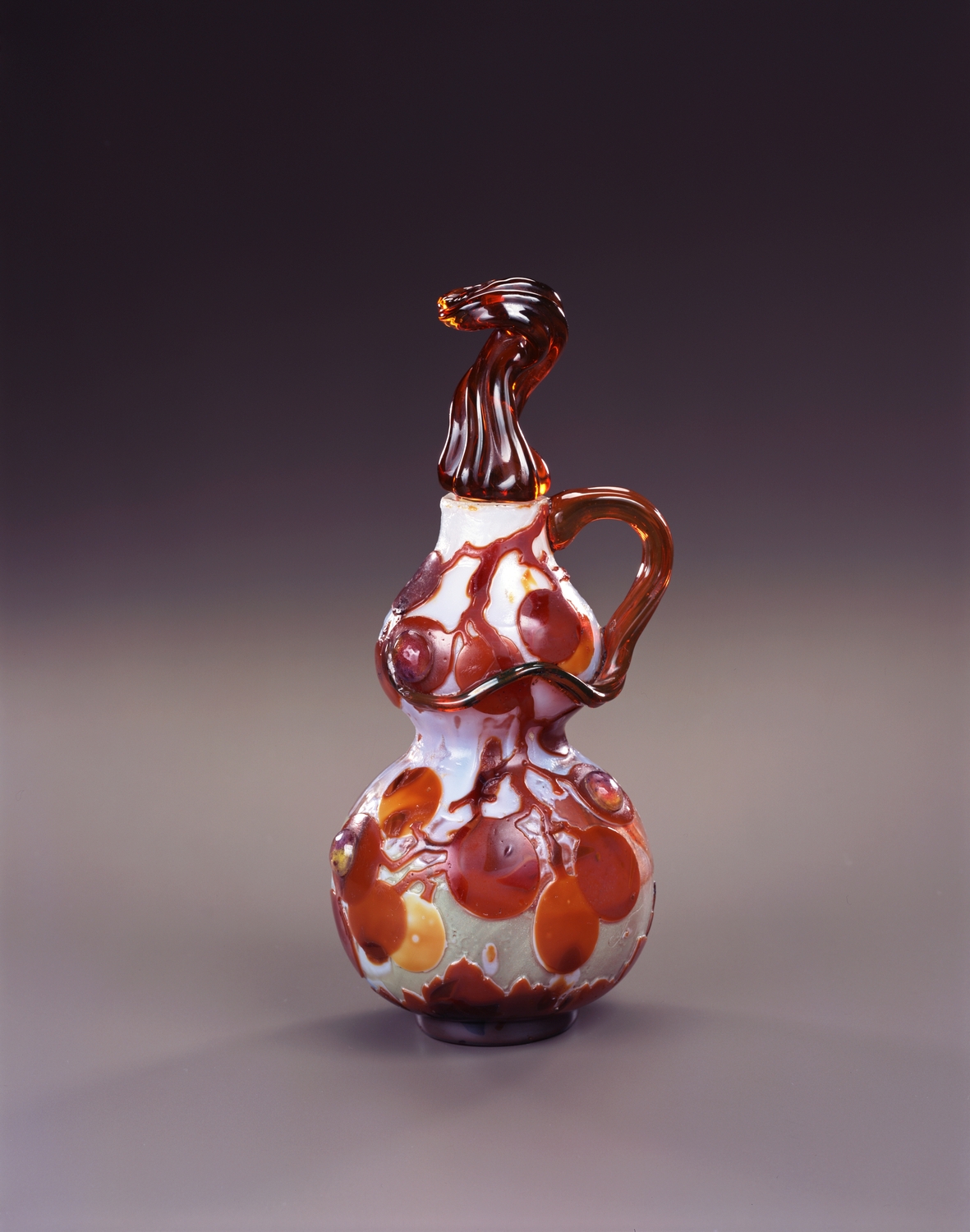
葡萄文蓋付瓶
エミール・ガレ
ヒョウタン形の瓶で、透明地に白、淡緑色、濃淡2色の茶色を重ね、エッチングで葡萄の房を彫刻している。葡萄の実の3ヵ所にカボションが載せられていて、各々グラヴュールで研磨仕上げがなされている。蔓の形状にデザインされた取手は、アプリカシオンでガラスが熱いうちに熔着されたもの。栓は透明地に茶色を被せた2層被せガラス製。エミール・ルーベ大統領からロシア皇帝に献上されたガレ作品12点の内に、これと同形作が含まれている。1902年5月24日付『イリュストラシオン』誌に掲載された図版では、栓がない状態の瓶が確認できる。(『名作選』 2007)
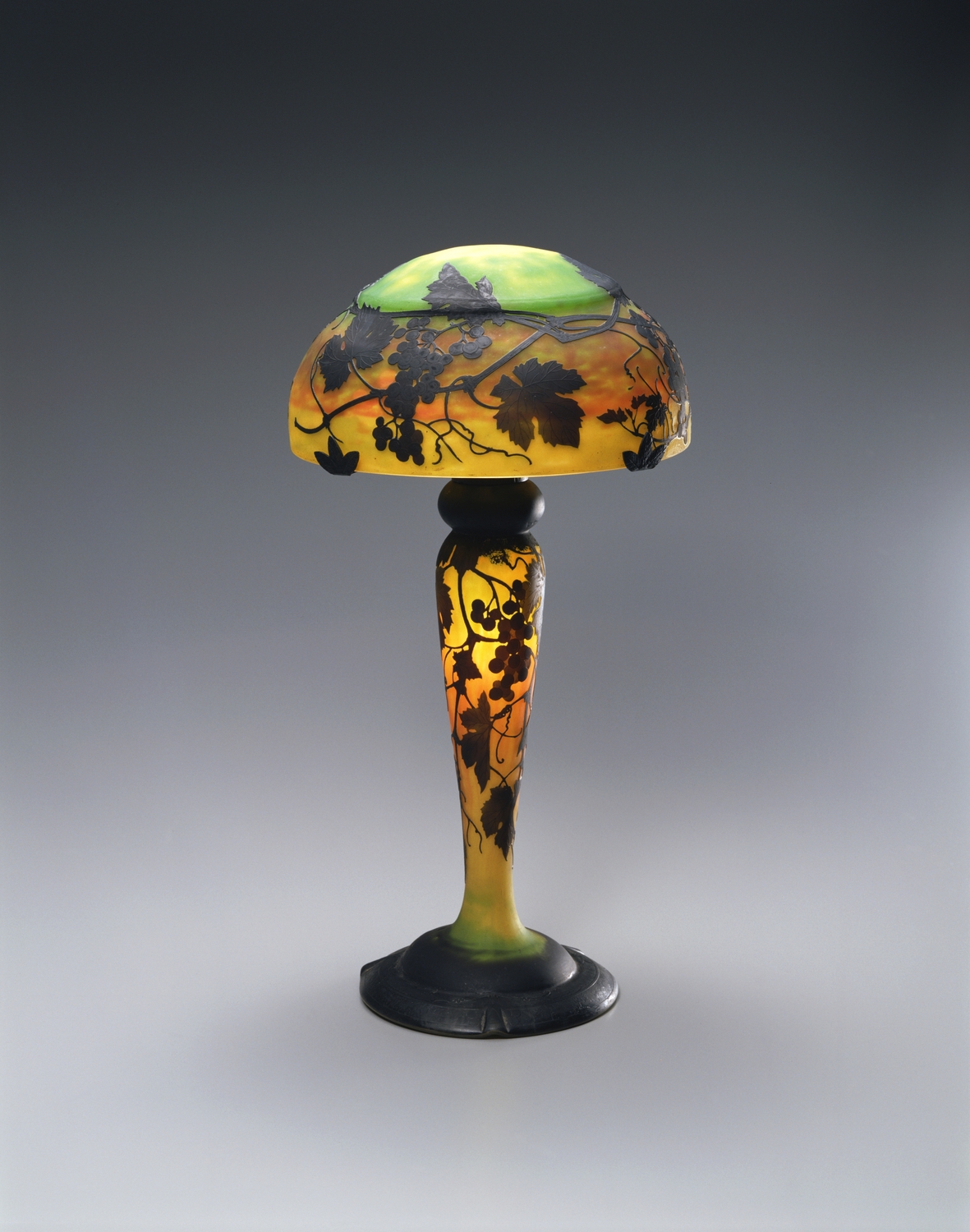
葡萄文ランプ
ドーム兄弟
黄色、緑、オレンジを段階的に練り込んだ素地に暗褐色を被せ、エッチングで葡萄の枝を彫刻している。ドームとしてはかなり大型といえるサイズのランプで、電球をともす葡萄畑の黄昏を連想させる情景が浮かび上がる。食堂などにふさわしいテーマの照明器具である。(『名作選』 2007)
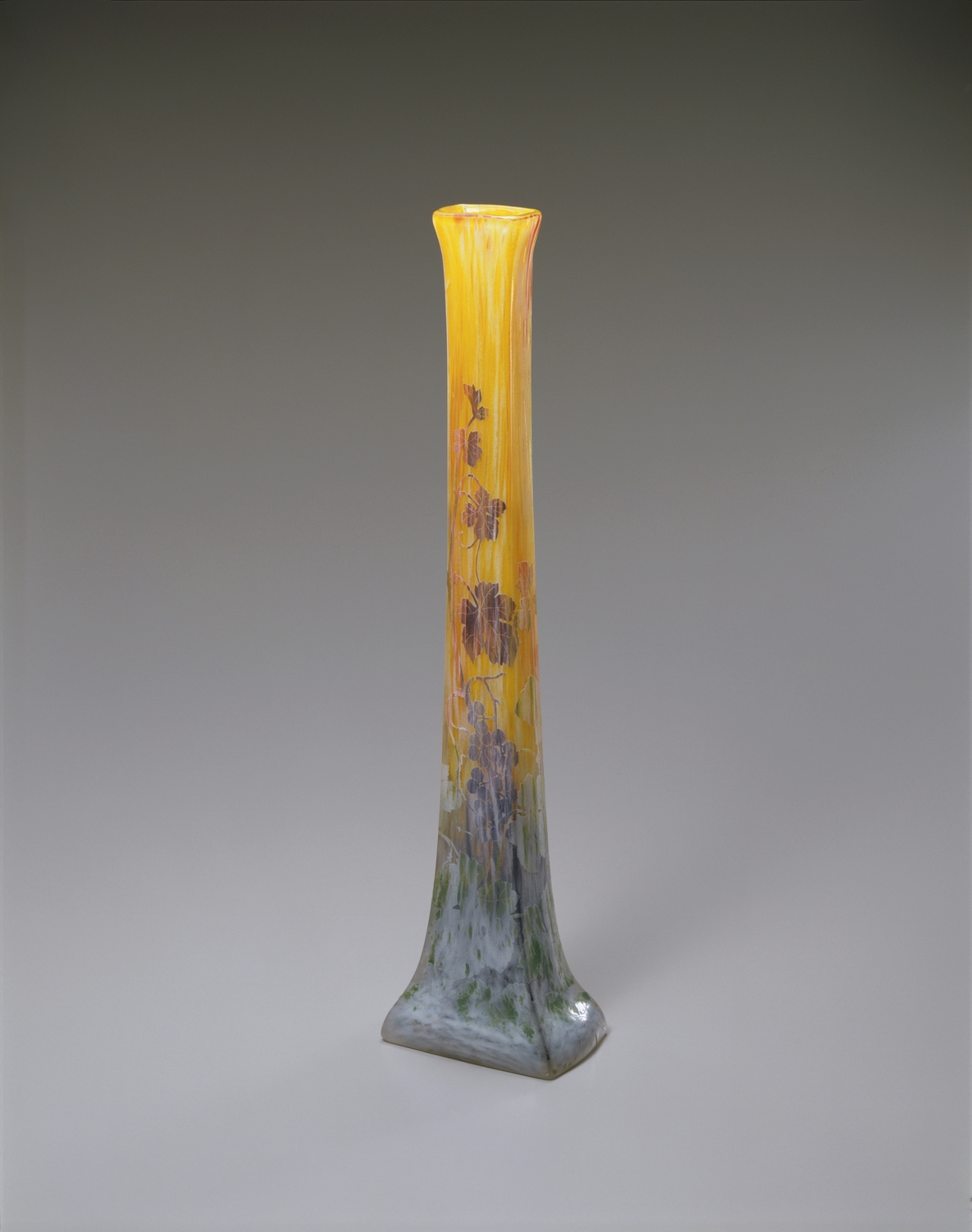
葡萄文花器
ドーム兄弟
ガラス熱い段階で黄色やオレンジ、紫、緑、白などの色ガラス粉を練り込んで、一気に引き伸ばし、角張った細長い花器に成形したもの。飴細工のように粘りをともなって変形したガラスの表面には、細く長い糸のような状態に色ガラスが流れた形跡が浮かんでいる。その表面をエッチングで削り、実をつけた葡萄の小枝を浮き彫りしている。(『名作選』 2007)
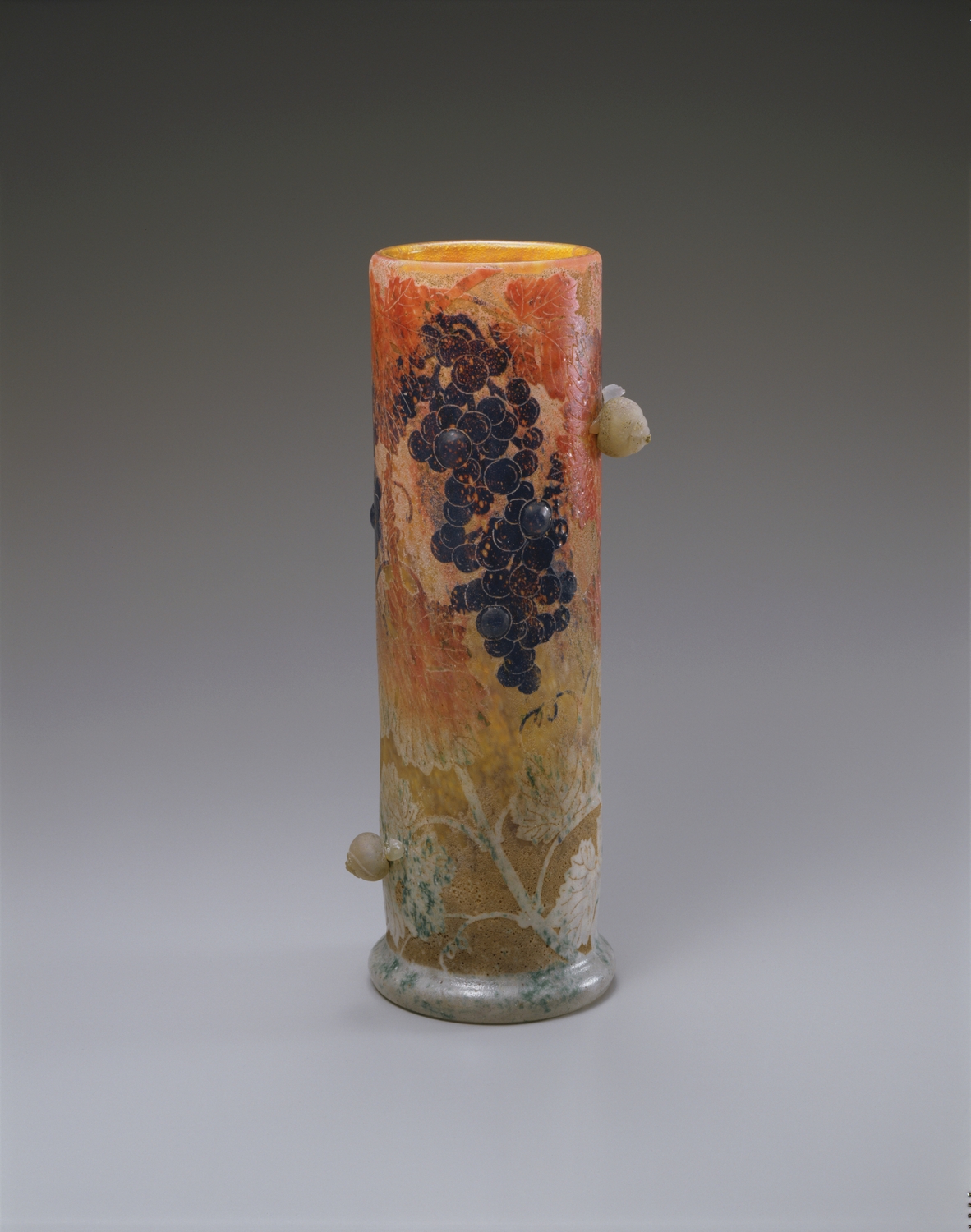
葡萄とカタツムリ文花器
ドーム兄弟
ヴィトリフィカシオン技法による赤や青紫、白、緑などを被せた被せガラス。エッチングによってたわわに実った葡萄の房を浮き彫りし、その中のいくつかはカボションによって丸く盛り上がっている。アプリカシオン技法で溶着したカタツムリは、葡萄の若葉を食べて育つエスカルゴであろう。畑の中の貝と呼ばれ、古代ギリシアから食用に供されているカタツムリである。同種類の文様を施したガラス器やランプなどが多数存在する。(『名作選』 2007)
Videos
Past Exhibitions
| Title | shusai | Place | open | close |
|---|---|---|---|---|
Institutions and External Links
葡萄畑とワイナリーに囲まれた図書館。地域の基幹産業である「ぶどうとワイン」の資料収集を行っており、毎年10月~11月に「ぶどうとワインの資料展」を開催している。
山梨県峡東地域(山梨市、笛吹市、甲州市)の「葡萄畑が織りなす風景」は、文化庁により「日本遺産」に認定されている。
農林水産省公式Webマガジン。2020年6月号から週刊化された。「ふるさと給食自慢」や「達人レシピ」などの連載を載せている。
「栄養と料理」(女子栄養大学出版部)をデジタル化し公開。フリーキーワードからレシピ等が検索できる。
国立科学博物館附属自然教育園内に生息している生物の種名や写真を調べることができる。
国立科学博物館筑波実験植物園内の植物を検索することができる。研究者ノートなど専門的な解説もあり。
References
- 柏書房
- 木村陽二郎 監修,植物文化研究会, 雅麗 編,柏書房
- 仲田道弘 著,山梨日日新聞社
- 麻井宇介 著,日本経済評論社
- Responsibility
- Secondary Usage
- Last updated
- September 11, 2023