.jpg)
図屏風
金箔に描かれている図屏風。その魅力や凄さに気づいてもらえると嬉しいです。
こんにちは。この博物館では、日本を代表する図屏風の凄さを紹介したいと思います。
時代順で見る図屏風
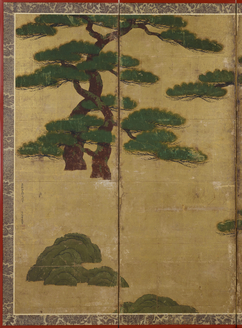
- Pine Trees
伝土佐光信筆,Attributed to Tosa Mitsunobu (1469–1523),東京国立博物館,Tokyo National Museum
<p>This folding screen features rocks and two sets of paired pine trees against a gold-leafed background. The tree trunks are painted in brown with no outlines. They form 'S' shapes as they rise sinuously upwards. The rounded, green leaves are also drawn without contours and their blurry edges create a soft, gentle impression. The artist has given the work a sense of perspective by placing the larger pair of pines in the bottom right and the smaller pair in the top left. They lie against a flat gold background with no clouds or land surfaces.<br /><br />Folding screens depicting trees and plants against a gold ground were a staple of 15th century literature, but real-life examples are quite rare, thus making this a very valuable work.<br /><br />On the bottom left, an inscription by the Edo-period painter Tosa Mitsuoki attributes this work to Tosa Mitsunobu, a painter during the late Muromachi period. Though this cannot be confirmed, the work is thought to date back to the 16th century, when Mitsunobu was indeed active.</p>
館長からの一言
金箔の上に石と松が描かれているシンプルな絵ですが、侘び寂びを感じられる室町時代らしい作品です。
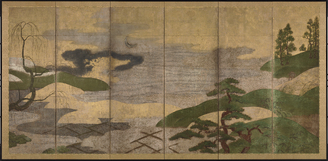
- Landscapes with the Sun and the Moon
東京国立博物館,Tokyo National Museum
<p>This is a set of two large six-paneled folding screens.<br /><br />The screen to your right depicts a spring scene of blooming cherry blossoms, while the screen to your left shows autumn turning to winter across a harvested rice field. On closer inspection, though, the two screens create strikingly different impressions. With its undulating cherry and willow trees and its surging streams, the right-hand screen exudes a sense of dynamism. In contrast, the left-hand screen radiates serenity with its formalized depiction of flowing water, its gentle pastoral views and its distant, snowcapped hills.<br /><br />The clouds on the right screen are formed from gold and silver leaf that has been torn up or cut into different-sized pieces. Most of the clouds and hills on the left screen, meanwhile, are created through the application of gold and silver foil. This creates an altogether more becalmed atmosphere. Furthermore, the cherry petals and bridge parapet on the right are given a three-dimensional aspect by the layering of paint. This technique is more-or-less absent from the left screen. Judging from the different compositions and painting methods, not to mention the discontinuity between the screens, it is thought they were originally separate works that were combined at a later date.<br /><br />Of particular note are the depictions of the sun on the right and the moon on the left. Both heavenly bodies are made from gold- and silver-plated metal plates. This was a popular technique at that time.</p>
館長からの一言
室町時代の屏風図の中でも、華やか。でも、どこか室町時代の侘び寂びを感じられる絵です。
- Chinese Lions
狩野永徳 、狩野常信,〈right scereen〉 Kano Eitoku,〈left scereen〉 Kano Tsunenobu,皇居三の丸尚蔵館,The Museum of the Imperial Collections, Sannomaru Shozokan
<p>The right screen is famous the confirmatory work of Kano Eitoku ( 1543-90 ), a master of the Momoyama art world, identified by its colophon by Kano Tan' yu. There's no doubt that this is by Eitoku because of the impressive and valiant depiction of imposing tigers striding among rocks with strong brushwork in spite of simple composition. The left screen was painted to match the right by Kano Tsunenobu ( 1636-1713 ) afterward, and the two were passed down to the present as a pair.(「New Edition Grace, Beauty and Inqenuity-Masterpices of the Museum of Imperial Collections, Sannomaru Shozokan Vol.1」2003)</p>
館長からの一言
狩野永徳の代表作です。金箔が迫力のある2頭の獅子をさらに際立たせているゴージャスな作品です。
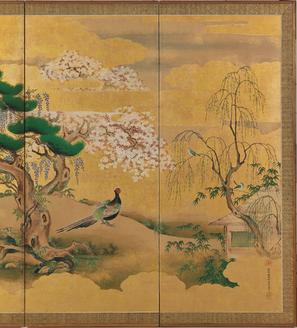
- Birds and Flowers of the Twelve Months
狩野永敬筆,By Kanō Eikei (1662–1702),東京国立博物館,Tokyo National Museum
<p>These screens visually depict poems about birds and flowers of the twelve months by the medieval poet Fujiwara no Teika (1162–1241). The poems were considered essential knowledge for aristocrats and samurai lords at that time.<br /></p><br /><p>This is a set of two six-panel folding screens. The 12 panels are decorated with a variety of flowers and birds, with cherry blossoms, wisteria, chrysanthemums and other flowers blooming in tandem with the changing seasons.<br /><br />The work was painted in the 17th century, during the Edo period, but it is based on a set of 24 waka poems by Fujiwara no Teika, a poet who lived during the early Kamakura period, from the 12th to the 13th centuries, with each poem representing a flower or bird of the twelve months. Teika's poems formed an indispensable part of the education of nobles and samurai lords, with the poems also inspiring the creation of numerous paintings and crafts. This painting presents the poems in visual form.<br /><br />A flower and bird from each month are displayed on each panel, with January represented by a willow and bush warbler and February by a cherry blossom and a pheasant. The 12 panels form one contiguous scene ranging from right to left. Though other folding-screen paintings also depict motifs from the 12 months, these usually feature different paintings on each panel. This work is quite unique in the way it depicts one overarching landscape. With its seasonal birds, flowers, moons and sun, the painting seems to perfectly encapsulate the entire world in one unbroken scene. As such, it speaks volumes about the compositional powers of the artist Kano Eikei.</p>
館長からの一言
季節ごとに違う花が描かれています。それを一つの絵に凝縮したのにも関わらず、全くの違和感を感じずに見させることができる高度な技です。
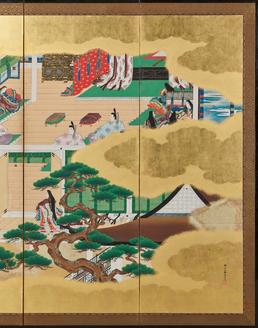
- The Chapters “The Picture Competition” and “The Butterflies” from The Tale of Genji
狩野〈晴川院〉養信筆,By Kanō Osanobu (1796–1846),東京国立博物館,Tokyo National Museum
<p>This is a set of two folding screens. Vivid scenes are depicted in rich green, blue, and red hues over a golden ground. These are lifted from the world's earliest novel, The Tale of Genji, which was written during the mid-Heian period, around 1000 AD.<br />The screen to your right features the 'Eawase' chapter of the novel. As the title suggests, it depicts an 'eawase,' or picture-matching contest. During these contests, participants were divided into left and right teams. Each team then presented a painting to be judged. The two boxes facing each other in the large room probably contain the paintings. Dancers clad in unusual costumes are seen on the left-hand screen. This is a scene from the 'Kocho,' or 'Butterflies,' chapter. Four children dance at a spring Buddhist ritual. They wear butterfly wings and hold bright yellow Kerria branches. The two scenes are not connected in the novel, but the screens are linked up here by the brilliant, white cherry blossoms. This bright, luxuriant work is infused with a sense of spring. </p>
館長からの一言
ギャラリーに飾ってある中で、最も新しい作品です。そのため、鮮やかな色彩を用いた絵が特徴です。