Jump to main content
/

Yurei-Yokai Collection - Ghosts, Monsters and Demons in Japanese Art

「福岡市博物館収蔵 幽霊・妖怪画コレクション」(2026/7/19~9/13)から展示資料をピックアップしてご紹介します!

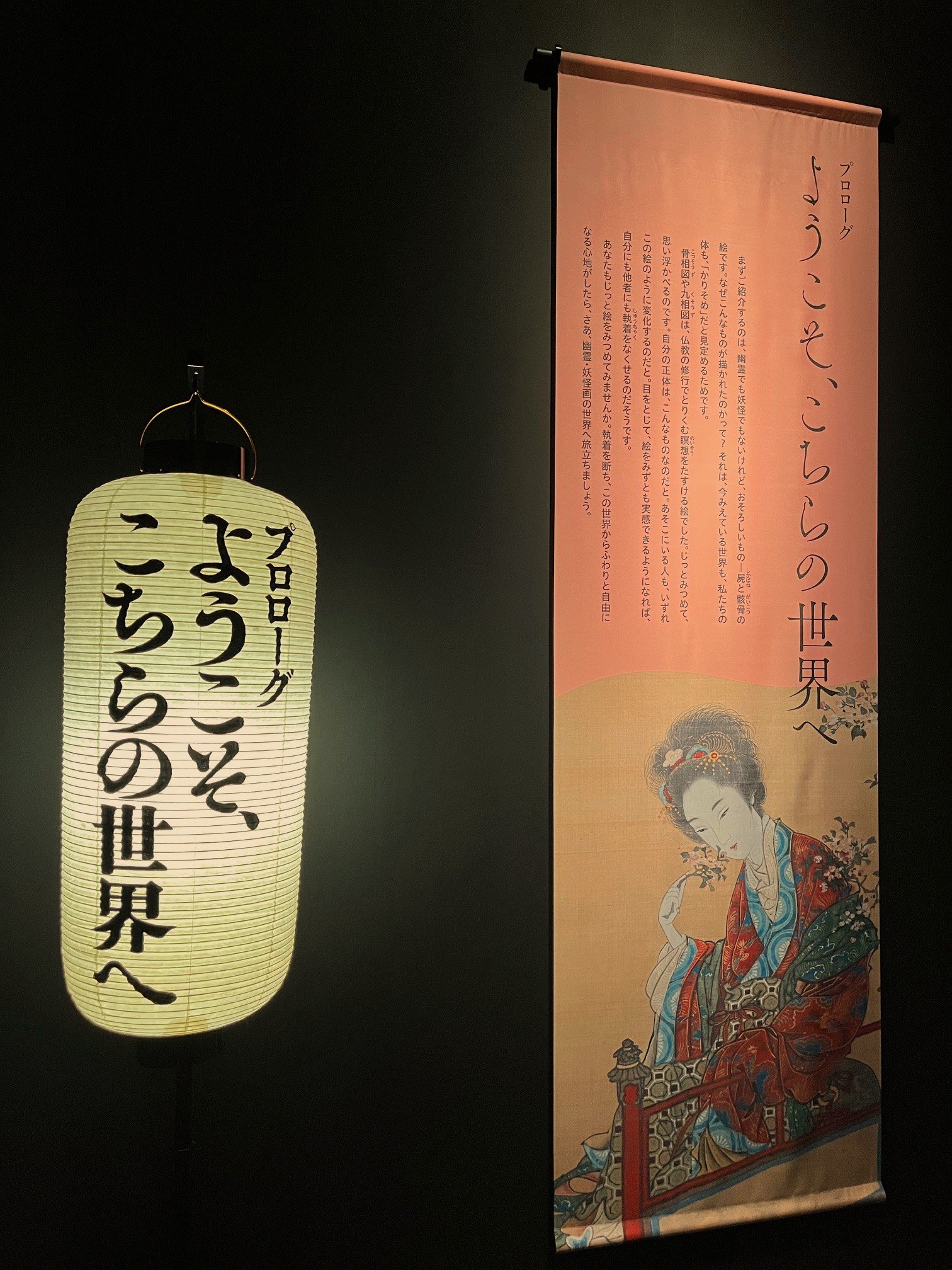
Prologue : Welcome to the Otherworld
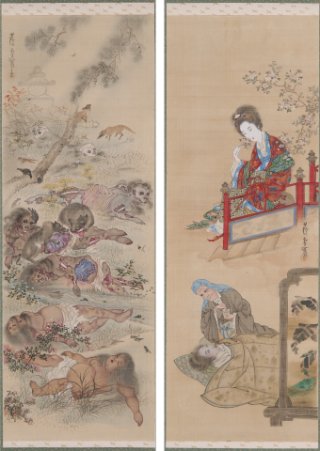
Paintings featuring corpses and skeletons are frightening, aren’t they? While they may not be ethereal like the spirits or the yokai, the first section of the exhibit focuses on these as its theme.
A skeleton seated in meditation on the waves - supposedly this painting has something to do with Buddhist meditation practice. Practitioners would imagine how their bodies decay after death until what remains of the body is just bones. Through this meditation, they sought to let go of attachment to the physical body and free themselves from worldly desires.
How would a gorgeous woman transform after death? This painting shows, in nine scenes, how her body decays, becomes a skeleton, and finally disappears. Although the depiction of death may seem disturbing, the final scene offers a different impression. After even the bones have vanished, a ray of light shines from the sky, suggesting hope or salvation. Based on Kusōkan, a Buddhist practice that reflects on impermanence and the need to let go of attachment, the artist transformed a religious subject into an emotionally moving work of art.

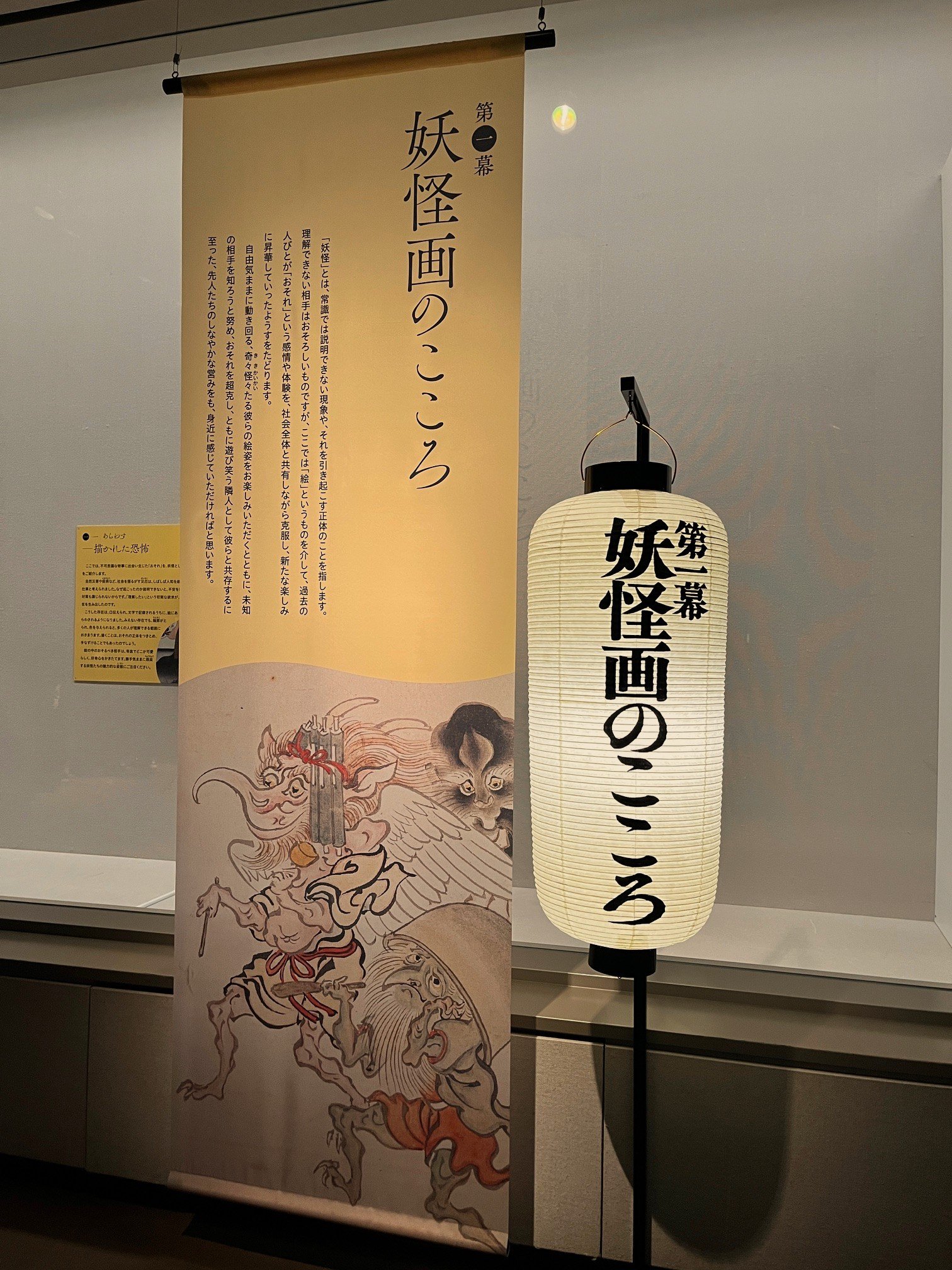
Part 1 : Depictions of yokai

Yokai refer to inexplicable or supernatural phenomena and the beings responsible for causing them. By depicting the feelings of terror and fright in art, humans provide them with form and substance. By transforming these raw sensations into figures that can be explained and related to, they gradually become interesting and even alluring to us. The first main section of the exhibit deals with these yokai and the feelings they stem from, and how by depicting them in art viewers were able to understand, overcome, and even find a form of enjoyment in the things that scared them.

1-1 Objects of Terror

Let us take a look at increasingly diverse ways in which yokai are depicted. While some portrayals are whimsical, designed to hype up well-known ghost stories, others are rather satirical, using yokai as a way to insitunate political grievances that were otherwise difficult for the artist to explicitly express.

Pandemonium: the Night Parade of One Hundred Demons

A procession of monsters is making its way forward: demons, animal-like creatures, and everyday objects such as musical instruments and pots that have transformed into yōkai. This is known as the Hyakki Yakō (“Night Parade of a Hundred Demons”), this is a nocturnal procession of Japan’s supernatural beings. People during the Heian period (794–1185) believed that encountering this procession would bring them illness or, in the worst cases, even death. To avoid this, people stayed indoors, refrained from traveling in inauspicious directions, and relied on spells and blessings. However, by the Muromachi period (1336–1573), the “Hyakki Yakō” had become a popular subject in painting. Although originally regarded as terrifying, artists began to depict this procession as lively, humorous, and even playful.

Tap the ● or number to zoom in and explore each scene in this artwork.

1
2
3
4
5
18
6
7
8
9
10
11
12
13
14
15
16
17
1
Eerie yet somehow endearing Yōkai are floating in the dim. They are called Tsukumogami, spirits that have evolved from objects such as masks, candlesticks, Kotos (Japanese harp), and tea bowls. In the foreground, Tsukumogami which used to be old tools are taking a gaze at a small tea whisk and a tea caddy. It was once believed in Japan that objects could acquire a spirit and turn into Yōkai after many years of existence. Perhaps this painting depicts the moment a new Tsukumogami is born.
Rising from the stormy sea is a monster known as Umibōzu, a creature said to capsize ships. People have long portrayed the terrifying power of huge waves and storms as monsters like this. This print is part of a series illustrating ghost stories associated with the fifty-three post stations of the Tōkaidō Road. It is based on a tale in which a sailor is asked by the monster, "Are you not afraid?""When he replies, "There is nothing more frightening than the world itself," the monster disappears, and the ship is able to continue its voyage safely.

1-2 Familiar figures of the Supernatural

Catalogue of Thirty Yokai

30 large yokai depicted here in vivid colors inspired modern manga artists to create manga characters in various titles. As a result, many yokai here —such as “Nurarihyon”— are familiar to Japanese people in the modern era. Among the yokai, there are ghosts as well. In modern times, yokai—which do not take human form but rather embody phenomena—and ghosts, which are in human-shape and were once human, are recognized as mutually exclusive. This painting, however, reveals that ghosts were considered one of the yokai back then.

Tap the ● or number to zoom in and explore each scene in this artwork.

1
2
3
4
5
6
7
8
9
10
11
12
13
14
15
16
17
18
19
20
21
22
23
24
25
26
27
28
29
1

1-3 Invented Monsters

Let us take a look at increasingly diverse ways in which yokai are depicted. While some portrayals are whimsical, designed to hype up well-known ghost stories, others are rather satirical, using yokai as a way to insitunate political grievances that were otherwise difficult for the artist to explicitly express.

A child carrying tofu on a tray - bizarrely walking barefoot with a torn hat. He is easily recognized as a yokai from his large eyes and long, snake-like tongue. He is the “Tofu Kozo (Tofu Boy).” The Tofu Kozo is a character from popular fiction who first appeared about 250 years ago. Since there are no eyewitness accounts or folklore associated with him, he is believed to be a completely fictional character. He is not portrayed as mischievous or malicious; rather, he is depicted as having a timid personality. Tofu Kozo was such a familiar yokai to the public at that time, appearing in novel illustrations, fan designs, and toys.
A giant skeleton is peeking into the mansion it destroyed. What is being attacked by the skeleton is two Samurai. This painting depicts a scene in which Princess Takiyasha, seeking revenge on behalf of her father—who was executed as a traitor—is right about to face off against her enemy, operating the giant skeleton. While the original story features numerous life-sized skeletons, the artist of this painting has depicted the vast horde of skeletons as a single, gigantic skeleton. This is a masterpiece that showcases the artist’s boldness and dramatic flair.
A multitude of yokai are fleeing from right to left, much like the Hyakki Yakō (“Night Parade of a Hundred Demons”). They all take the form of traditional lighting tools, such as candles, paper lanterns, and gas lamps. Above them, a spider-like light bulb yokai emits a dazzling light. Inspired by scenes in Hyakki Yakō scrolls where fireballs drive away monsters, the painting shows old forms of lighting being overtaken by the light bulb. Modeled after the powerful Tsuchigumo yokai, the small light bulb symbolizes the strength of new technology. Painted about 100 years ago, it satirizes the social changes brought by the spread of electric lighting.

Part 2 : Depictions of ghosts and spirits
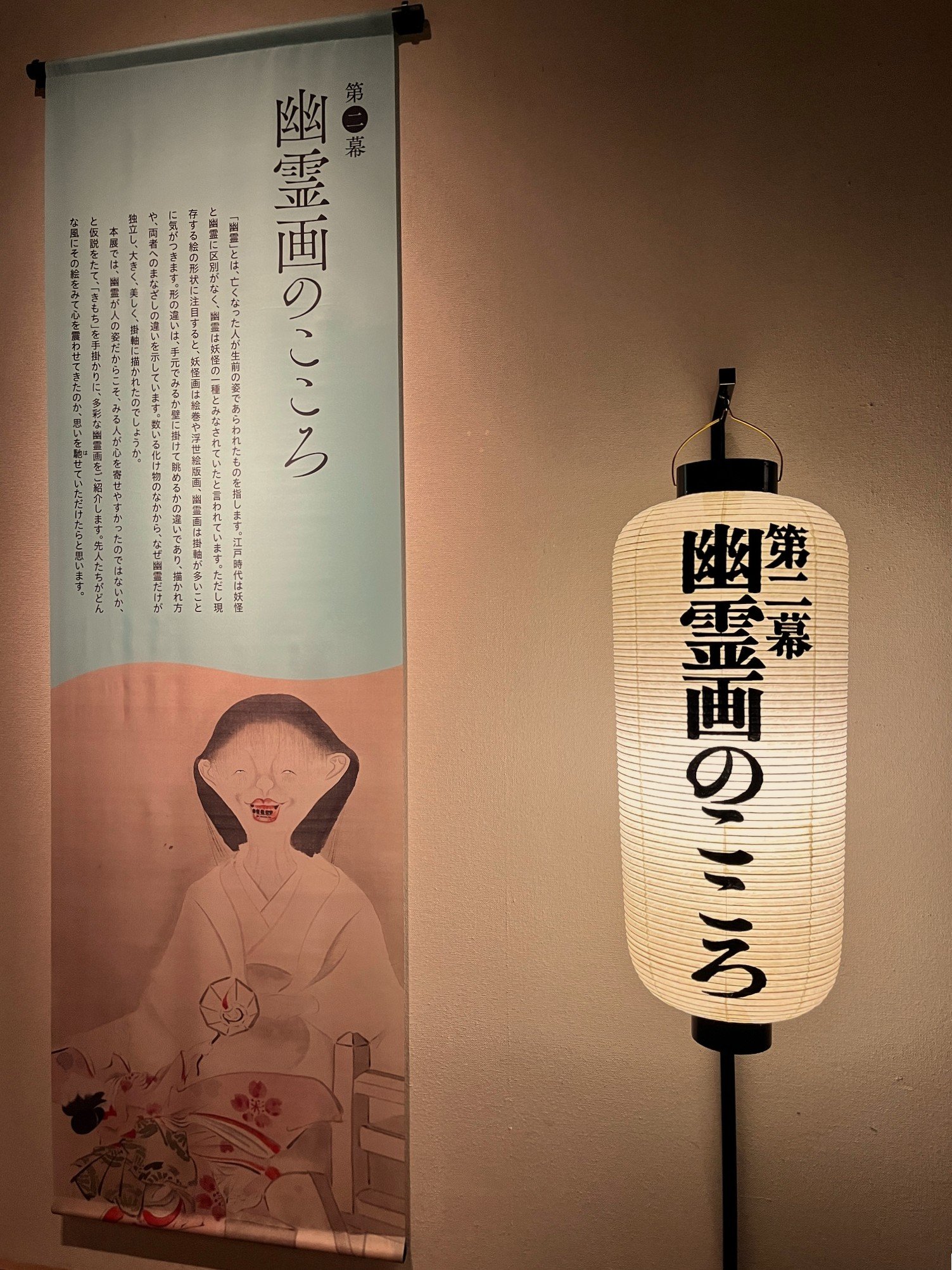
In contrast to yokai, ghosts refer to the spirits of those who have passed on. In ancient Japan, these ghosts and spirits were said to be among the different types of yokai, however as time went on, they grew to be increasingly distinguished from one another. Eventually, ghosts became an artistic theme in their own right.

2-1 Ghost Paintings of Mourning and Remembrance

In the latter half of the 18th century, the painter Maruyama Ōkyo created a masterpiece; a painting of a ghost that would heavily inspire artists of his own time and beyond. A beautiful female ghost whose lower body dissolved into mist, appears as though she were floating in mid-air. This art style became a definitive archetype for ghost paintings. Such beautiful yet ethereal portrayal embodies a sense of mourning and remembrance for the deceased.

A legless woman in a white kimoto is smiling quietly. Although she is clearly a ghost, this painting does not instill fear in the viewer. This ghost painting bears a striking resemblance to that of Maruyama Ōkyo. The figure standing with her head bowed to the left, her loose hair, the white kimono, her right hand resting on her chest, and the absence of feet—these elements became standard features in ghost paintings created after Maruyama Ōkyo’s works. It is also worth paying attention to the frame depicting autumnal flowers and grasses, with their petals scattered. This design, which evokes a sense of death through withered plants, forms a single cohesive work of art together with the portrayal of the ghost itself.
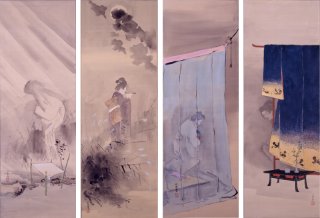
A single female ghost appears through the changing seasons. In spring, a kimono and an altar for memorial rites are displayed. The woman in the background is already dead; now a ghost, she looks anxious. The flowers and plants on the kimono symbolize spring and indicate her recent death. In summer, beneath a light blue mosquito net, she cradles her sleeping child dressed in red. Her sorrow and tenderness reveal the anguish of leaving the child behind. In autumn, the ghost wanders after leaving the house where she once lived. Silver grass and the moon symbolize the season and create a lonely atmosphere. In winter, beside a white cloth used to mourn a woman who died in childbirth, the ghost appears faint and blurred. Gazing at the sky, she seems finally released from suffering. As the seasons pass, the ghost gradually fades, offering solace to those grieving a loved one.

2-2 Fear and Entertainment in Ghost Paintings

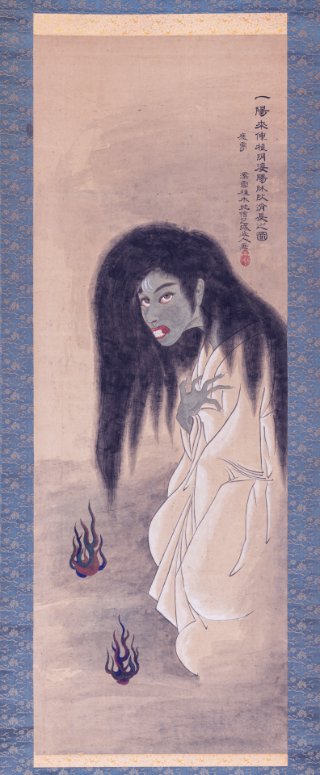
Some paintings of ghosts evoke a terrifying impression. Disheveled hair, bared teeth, an eerie smile, and an emaciated body are elements frequently found in such ghost paintings. As contemporary Kabuki productions start to feature ghostly apparitions, blood-spattered depictions of ghosts have also emerged.

A ghost appears, clutching a severed head in its mouth. Its eyes, adorned with red and gold, imply that it possesses supernatural power. Reeds growing nearby suggest it is situated at a waterfront or a marsh; waterside environment is one of the boundaries between our world and the otherworld. This painting was commissioned by the renowned 19th-century Kabuki actor Onoe Kikugorō V from the spirited ukiyo-e artist Kawanabe Kyōsai. Kikugorō excelled in performing a role in tales of the supernatural. He was known to collect paintings of ghosts, perhaps to aid in developing his roles. He and Kyōsai appeared to have had a close friendship, and Kyōsai even created ghost paintings inspired by Kikugorō’s ghost paintings collection. Their friendship is the great example of how the artist and the collector could mutually influence one another.
The ghost of Oiwa—a wife who was poisoned and disfigured by her own husband before being murdered—appears before him. This painting depicts a scene from a Kabuki play based on that famous ghost story. In the stage production, the wife's ghost would appear from inside a large paper lantern. In this painting, the hideously distorted face of a wife appears on a large paper lantern, causing her husband to recoil in shock. Until this day, people may refer to someone with swollen eyes as s/he looks like “Oiwa-san”.

2-3 Humor, Everyday Life, and the Expansion of Ghost Paintings

The more widespread ghost paintings became, the more diverse their forms of expression and functions developed. We also present paintings depicting people in a panic after mistaking something else for a ghost, as well as memorial prints issued upon the passing of famous Kabuki actors.
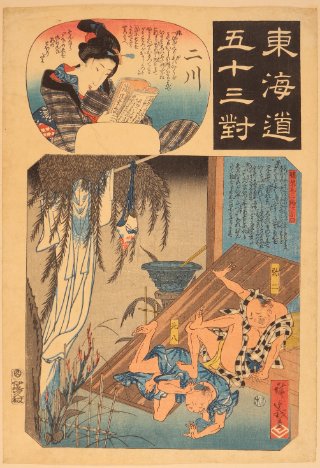
Depicts an episode from a best-selling travelogue featuring a male duo. The pair are shown collapsing in shock, terrified by what appear to be a ghost and a severed head beneath a willow tree. However, a closer look reveals that what looked like a ghost was actually a white *juban* (traditional undergarment) hung out to dry, while the ""severed head"" was merely a cloth bag patterned with butterflies. At the top of the composition, a woman is laughing as she reads the story. Willow trees were planted along riverbanks for erosion control. Given that people sometimes drowned in the river—and it used to be darker with a lot less street lights—it is understandable how the sight of slender willow branches swaying in the wind could have been mistaken for the appearance of a ghost. For this reason, Japanese stories frequently feature willows and ghosts together.
Unknown figure, not even clear if it is in human form. At the top of the composition, a Zen monk has inscribed a text extolling Sen no Rikyū—a figure in the world of tea ceremony held in the same high regard as Shakyamuni in Buddhism and Confucius in Confucianism. This text implies the figure depicted is Rikyu, the man who perfected the art of *chanoyu* (the tea ceremony). Viewed in this light, one can visualize him holding a ladle for scooping hot water, with the kettle used to boil it positioned to his left. However, it appears it has been too long since Rikyu’s death for his spirit to sustain a human form; it might be better described as a lingering psychic imprint rather than a ghost or apparition. Even in such a state, Sen no Rikyu remains engaged with the way of tea.
Exotic-looking Ghost Depicted as aan Auspicious Image
In the upper right corner of the composition, there is a sentence meaning, "Just as spring follows winter, things will take a turn for the better after a series of misfortune." Paintings of ghosts depict the very depths of misfortune. They embody the wish that, having reached that extreme, good fortune will surely follow. In the Kansai region such as Osaka and Kyoto, allegedly there were people who sought after paintings of ghosts in the hope of business prosperity. These paintings may have been believed to be effective simply by virtue of being owned, rather than through the act of viewing them. In the olden days, Japanese people used to engage with such paintings in a manner quite different from the modern perspective, which views art primarily as something to be looked at and appreciated.

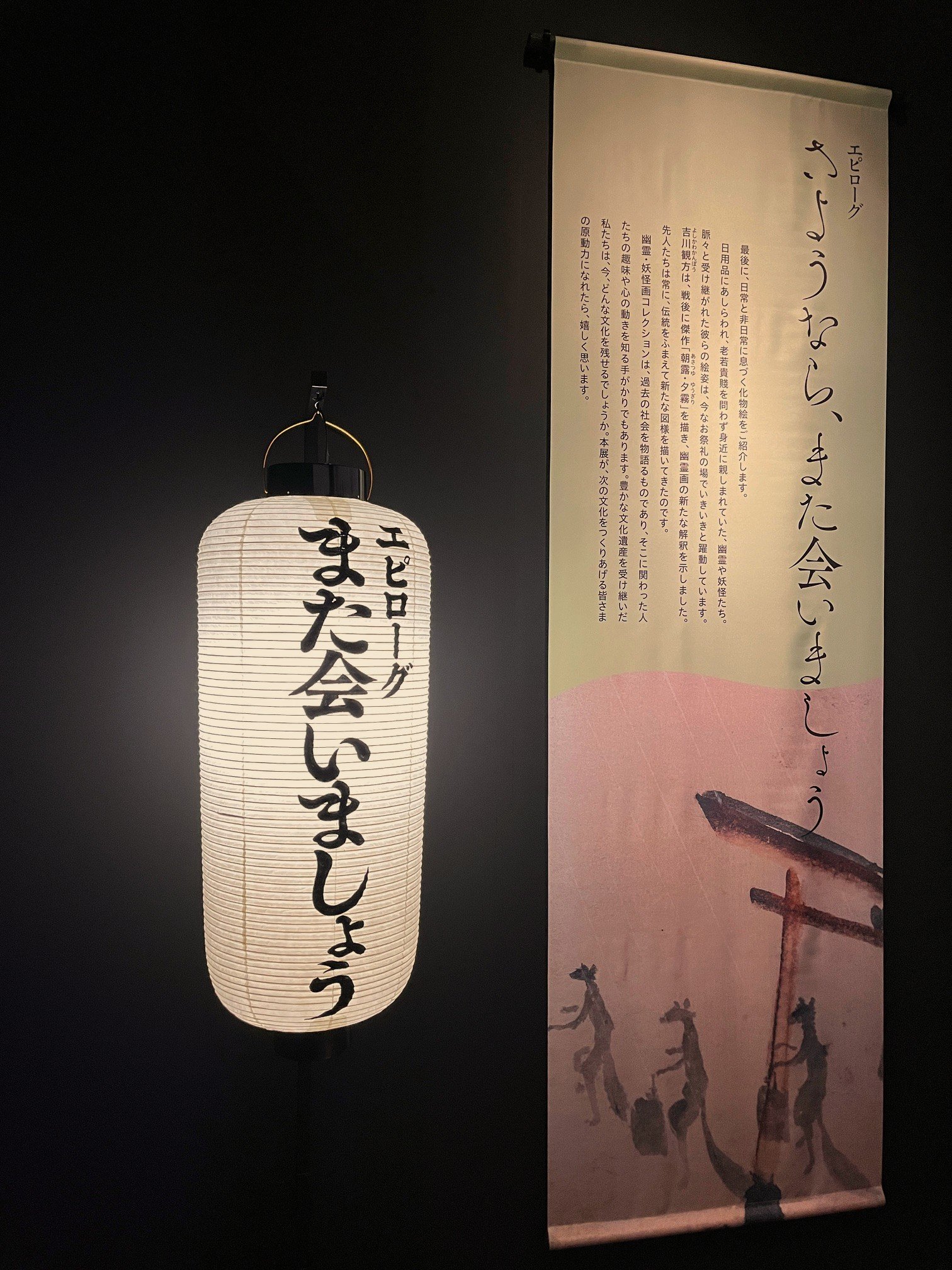
Epilogue: Until we meet again

This unique exhibit introduces paintings of spirits that manifest in everyday items as well as those that appear only on festival nights. Although society and people’s ways of thinking have changed over time, these monsters have always existed between the everyday world and the extraordinary world, and it feels as though they are still right beside us today.
This toy print was used for a children's game in the Meiji period (1868–1912). Similar to a modern trading card game, it could be described as a set of “Meiji-era yokai cards. According to the instructions, cards were first distributed to the players with the pictures hidden from view, after which paper lanterns were handed out. The game is supposedly intended at guessing the names of the yokai depicted on the picture cards inside lantern-shaped toys. The cards feature a variety of yokai, including the Hitotsume Kozō (One-Eyed Boy), Nogitsune (Wild Fox Spirit), Mitsume Nyūdō (Three-Eyed Monk), Fukunezumi (Lucky Rat), Bakeneko (Monster Cat), and Tanukiyama.
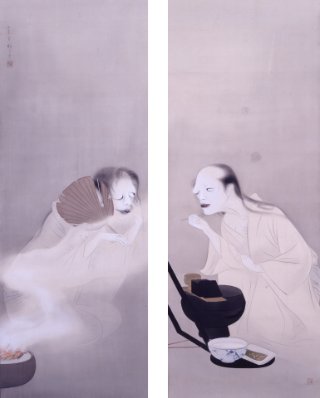
Two female ghosts depicted here are iconic Japanese ghosts. The ghost on the right is named Oiwa, and the one on the left is named Okiku. Each of them suffers cruel treatment and becomes a terrifying vengeful spirit in a story. Being vengeful spirits, they are normally depicted as ugly and grotesque. However, the two gentle women in this painting appear as if they are enjoying their ordinary daily lives, chatting. It is said that some ghost paintings were created as a way to offer prayers to and comfort the spirits depicted. This painting was created shortly after the end of World War II, a time when Japanese society was in a state of great turmoil. The artist may have painted it to offer solace—through these ghosts—for the many lives lost in the war and the cultural decline.
Otoro-e (Large-Scale Lantern Painting): Iwami Jutaro Slaying the Hihi
This is a story of a samurai who rescues a woman kidnapped by yokai. Leading the yokai is a giant monster known as a Hihi. This painting is one of a series of giant lantern images displayed during Ōhama Nagare Kanjō, a traditional festival in Fukuoka City. For nearly a century, its dramatic imagery has amazed and entertained festival visitors.

関連ギャラリー