DISH, blue-and-white porcelain with baoxianghua scroll design 青花 宝相華唐草文 盤せいか ほうそうげからくさもん ばん
Description
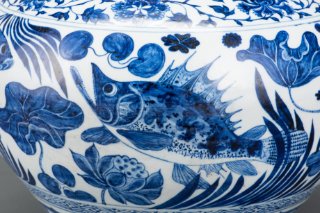
This is one of the precious examples of early blue-and-white ware of the Joseon dynasty. The flat and smooth surface bears a baoxianghua flower in the center and five more flowers radiating outward. Such motif resembles those found in the blue-and-white porcelain of the Hongwu period (1368-98) of Ming dynasty China. The flattened mouth rim also suggests Hongwu style, as a metal dish having the same form was excavated from the tomb dated 1370. An illustration of this type of dish along with a golden cup can be found in the section Oryeui (Five Rites) in Sillok (Annals) of the reign of King Sejong (1418–1450), suggesting that this dish was used as a tray or saucer for a ritual wine vessel. The underside bears the seven treasures, the decorative motifs found in artworks associated with Tibetan Buddhism. A sherd of a similar dish with pine tree and bamboo design was discovered at Kiln Site No.1 (an imperial kiln site) in Doma-ri, Gwangju-si, Gyeonggi-do, while another sherd with scroll design was found at Kiln Site No.5 in Beomcheon-ri, also in Gwangju-si.
Data source
The Museum of Oriental Ceramics, Osaka Collection Search
This database provides access to the images and information of 172 works (Chinese ceramics, Korean ceramics, and Japanese ceramics) that represent the collection of The Museum of Oriental Ceramics, Os...
Contents holder/Provider
Aggregator
The Japanese Council of Art Museums
The Japanese Council of Art Museums (JCAM) supports the accomplishment of mission of art museums and seeks to assist art museums in fully basing their activities in a social context. The organization holds an annual meeting, memorial forums at annual meetings, lectures, Curatorial Study Meetings, and Study Group activities every year. The information and reports generated by these various activities are then expected to be shared with member museums, the greater art-related world and the general public. JCAM was founded in 1952 with the aim of providing a forum for art museums in Japan to think and act together. The organization was registered as a general incorporated association on April 1st, 2020 and includes over 450 members (full members, individual members and supporting members).
Last updated
September 10, 2024