Description
Bizen province, located in the southeastern part of modern-day Okayama prefecture, flourished throughout medieval times as a major base of sword production, with many swords produced there from the late Heian period onwards. This also gave rise to a number of sword-making schools. The Ichimonji school in particular was a prominent smithery in Bizen during the Kamakura period, which lasted from 1192 to 1333. The swordsmith Sadazane is thought to have belonged to this school in the first half of the 13th century. The sword is quite short when measured from the tang, with a deep curve typical of swords from that era. Furthermore, the irregular width of the hamon, or the wavy pattern created during the tempering process, creates a complex pattern resembling a line of different-sized cloves. The sword is accompanied by outer fittings known as itomaki no tachi, whereby cord is wrapped around the handle area and the part that touches the hip. There are also gold-lacquered bellflower family crests on the sheath. These reveal that the sword was owned by the Arima family from the Kurume domain in Chikugo province, an area located in the southern part of modern-day Fukuoka prefecture.
Scholars consider this one of the finest blades by the 13th-century swordsmith Sadazane. His signature method of hardening the cutting edge resulted in the wavy white line running the length of the blade. The sword later became a prized heirloom of the Arima, samurai lords who ruled in northern Kyushu.
Data source
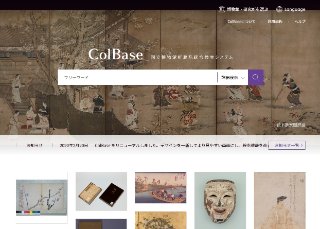
ColBase
"ColBase: Integrated Collections Database of the National Institutes for Cultural Heritage, Japan" is a service that enables a multi-database search of the collections in the four national museums (To...
Contents holder/Provider
Aggregator

National Institutes for Cultural Heritage
The National Institutes for Cultural Heritage (NICH) comprise four National Museums (Tokyo National Museum, Kyoto National Museum, Nara National Museum, and Kyushu National Museum) and two National Research Institutes for Cultural Properties (Tokyo National Research Institute for Cultural Properties, and Nara National Research Institute for Cultural Properties), as well as the International Research Centre for Intangible Cultural Heritage in the Asia-Pacific Region (IRCI) in Sakai City, for a total of seven institutions.
Last updated
July 20, 2026