Description
This sword was made during the Kamakura period, which lasted from 1192 to 1333. The accompanying scabbard and guard were made during the Edo period, which lasted from 1603 to 1868. The sword was made by Sukezane, a master swordsmith from the Ichimonji School who lived in present-day Okayama Prefecture. The wide blade and powerful appearance were common features of long swords from that era. The blade itself has a flamboyant tempering pattern that undulates sharply, like a string of cloves. The way to appreciate this sword is to be swept along by the rhythm of this pattern, as if viewing a monotone abstract painting. During the Kamakura period, the sword was hung loosely from the waist with the sharp edge facing down. In the Edo Period, though, the sword was inserted into the mounting so it could be carried at the waist with the sharp edge facing up. At that time, it was owned by the Tokugawa Clan and the clan crest of a triple hollyhock can be seen scattered across the outside of the mounting.
Sukezane was a 13th-century master swordsmith active in Bizen Province, a leading center of sword production located in western Japan. This blade by Sukezane features a vibrant, dynamic tempering pattern ([hamon]) along the cutting edge, which resulted from a meticulous steel-hardening process.
Data source
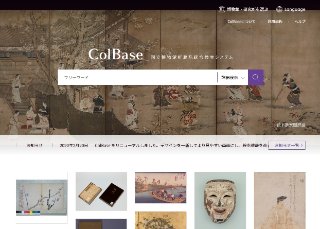
ColBase
"ColBase: Integrated Collections Database of the National Institutes for Cultural Heritage, Japan" is a service that enables a multi-database search of the collections in the four national museums (To...
Contents holder/Provider
Aggregator

National Institutes for Cultural Heritage
The National Institutes for Cultural Heritage (NICH) comprise four National Museums (Tokyo National Museum, Kyoto National Museum, Nara National Museum, and Kyushu National Museum) and two National Research Institutes for Cultural Properties (Tokyo National Research Institute for Cultural Properties, and Nara National Research Institute for Cultural Properties), as well as the International Research Centre for Intangible Cultural Heritage in the Asia-Pacific Region (IRCI) in Sakai City, for a total of seven institutions.
Last updated
July 20, 2026