Description
In the foreground stand trees which have shed their leaves. The ends of their branches stick out like crab claws, and the branches and trunks are twisted and intertwined. Behind this, you can see the river, the river bank covered in white snow, and mountains in the distance. This desolate landscape, with the withered trees set in front of a backdrop that seems to stretch horizontally forever, is just one of the imaginary landscapes beloved by Chinese intellectuals in the 10th century as a means for refining the spirit.
If you look closely, you can see two magpies painted on one of the withered trees on the left, and several ducks in the grass on the bottom right. There is very little color used in the landscape, but the birds are depicted with bright blue and orange flecks, evoking a powerful vitality and cheerfulness. There is also a flock of white-necked crows in the upper right corner. They grow larger toward the left, and if you follow them with your eyes you’ll also see several crows perched together on top of the right tree in the foreground. These motifs show the artist’s careful calculations in clearly depicting perspective within a boundless space.
The seal in the bottom left corner is that of the 14th-century literati artist Luo Zhichuan from the Yuan dynasty. His name doesn’t often appear in the history of Chinese painting, but due to his appearance in the Manual of the Attendant of the Shogunal Collection, a Muromachi-period book on art appreciation, we know that he had been a renowned painter in Japan.
Waterfowls rest by the waterside, long-tailed birds perch on the tree, and crows fly in the sky in this serene winter landscape. The painter Luo Zhichuan is not particularly well known in China, but he has long been highly acclaimed in Japan.
Data source
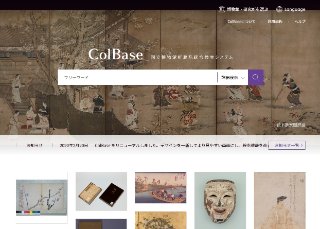
ColBase
"ColBase: Integrated Collections Database of the National Institutes for Cultural Heritage, Japan" is a service that enables a multi-database search of the collections in the four national museums (To...
Contents holder/Provider
Aggregator

National Institutes for Cultural Heritage
The National Institutes for Cultural Heritage (NICH) comprise four National Museums (Tokyo National Museum, Kyoto National Museum, Nara National Museum, and Kyushu National Museum) and two National Research Institutes for Cultural Properties (Tokyo National Research Institute for Cultural Properties, and Nara National Research Institute for Cultural Properties), as well as the International Research Centre for Intangible Cultural Heritage in the Asia-Pacific Region (IRCI) in Sakai City, for a total of seven institutions.
Last updated
July 20, 2026