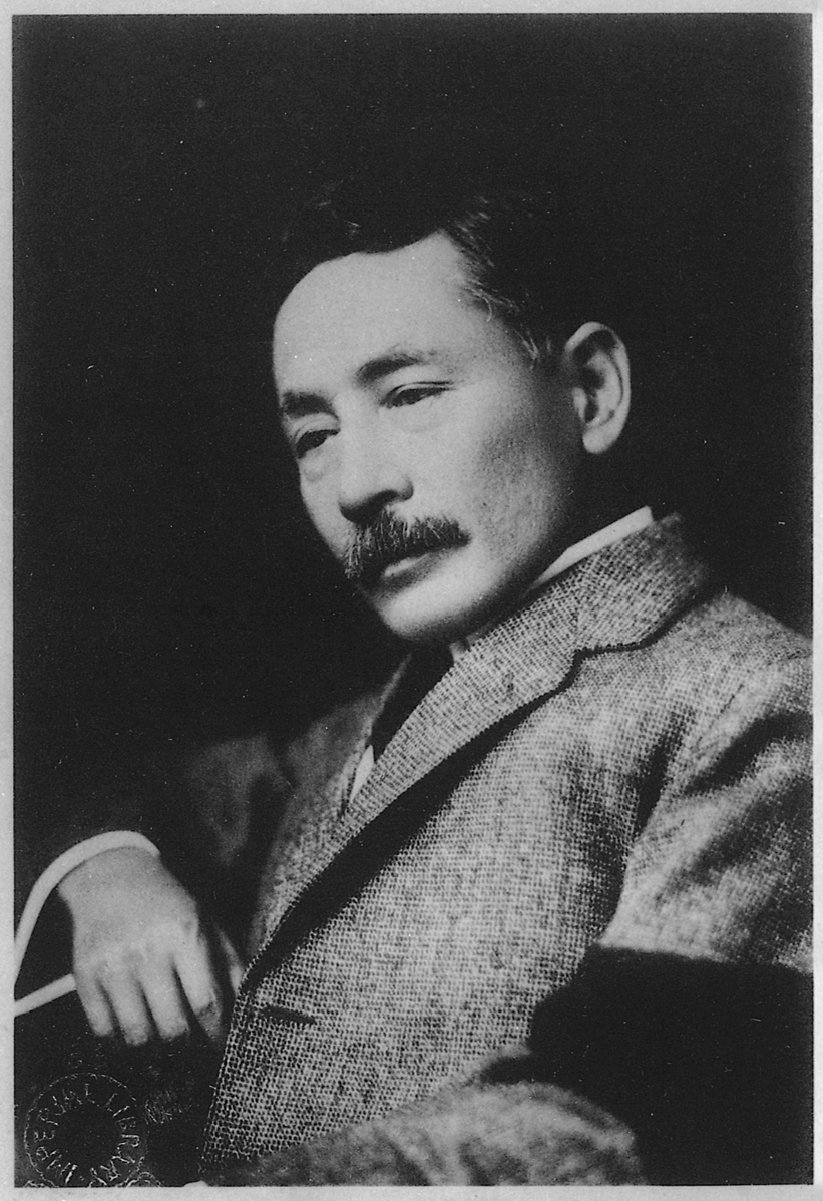
Natsume Soseki
Preeminent modern Japanese novelist who explored the plight of the modern intellectual in being self-aware
1867-1916
Natsume Soseki was a novelist and English literary scholar in the Meiji and Taisho periods (about 1905-1916). He was born as the youngest of five sons and three daughters to Kohei Naokatsu Natsume Kohei Naokatsu and his wife, Chie, in the town of Babashita in the Ushigome region of Edo (present- day Shinjuku, Tokyo), where his father was the town head. His given name at birth was Kinnosuke. Placed in foster care immediately after his birth, he was adopted the following year by Shonosuke Shiobara Shonosuke, but he returned to the Natsume family in 1875 (and was reinstated in on the family register in 1888). After dropping out of First Tokyo First Middle School, he studied at Nisho Gakusha and Seiritsu Gakusha, and entered Tokyo Imperial University through a preparatory course, graduating with a degree in English (in 1893). While at prep school, he met Shiki Masaoka Shiki, from whom he learned much about haiku and Chinese poetry. He used the pen name Soseki for the first time in an essay for Shiki Masaoka Shiki's Nanakusa shu ("Collection of Seven Grasses"). He worked as an English teacher at Tokyo Higher Normal School, Matsuyama Middle School, and Kumamoto Fifth High School. After his transfer to Kumamoto in 1896, he married Kyoko, the eldest daughter of Shigekazu Nakane Shigekazu, the head secretary of the House of Peers. In 1900, Soseki was selected sent by the Ministry of Education to study in England, and. (he left in September of the same year.) He stayed in London until 1902, returning to Japan in January 1903. While Although his time abroad gave him the opportunity to study literary theory and compare Eastern and Western civilization, it also led to is also said to have sent him into a "nervous breakdown, it is said." After returning to Japan, he taught English literature as a lecturer at Daiichi First High School and Tokyo Imperial University. His These lectures are collected compiled in the books Bungaku ron ("The Criticism of Literature") and Bungaku hyoron ("Literary Criticism").
His satirical portrayal of the world of a cat in Wagahai wa neko de aru ("I Am a Cat "), published in the literary journal Hototogisu in 1905 at the suggestion of haiku poet Kyoshi Takahama Kyoshi, caused a sensation. He and was followed this work with by Botchan, Kusamakura ("The Three-Cornered World"), and other popular works. In 1907, Soseki resigned from his position at Tokyo Imperial University to join the Asahi shimbun newspaper and devote himself to creative writing. Many of his novels, including Kojin ("The Wayfarer"), Kokoro ("Heart"), and Michikusa ("Grass on the Wayside") focused on the ethics and alienation of the modern intellectual. While writing his last major work, Meian (Light and Darkness), Soseki Natsume died of complications of chronic stomach ulcers while writing his last major work, Meian("Light and Darkness"). Upon In death, he was given the posthumous Buddhist name Bunken-in Kodo Soseki Koji and was is buried at Zoshigaya Cemetery in Toshima Ward-ku, Tokyo. In addition to the titles listed above, other major works of his include Gubijinso ("The Poppy"), Kofu ("The Miner"), Sanshiro, Mon ("The Gate"), and Higan sugi made ("To the Spring Equinox and Beyond"), and his short stories include as well as such short stories as Rondon-to ("The Tower of London") and Yume juya ("Ten Nights of Dreams"). Among his literary disciples were Toyotaka Komiya Toyotaka, Sohei Morita Sohei, Miekichi Suzuki Miekichi, Torahiko Terada Torahiko, Shigeo Iwanami Shigeo, Jiro Abe Jiro, Yoshishige Abe Yoshishige, Hyakken Uchida Hyakken, and Ryunosuke Akutagawa Ryunosuke, who would gather at Soseki's the Natsume house for what came to be called the "Thursday Meetings."
Related People, Things and Events
Books
Biographies and critical biographies
Books related to Mokuyokai (“Thursday Club”) gatherings
Related Works
Letters and postcards
Videos
Past Exhibitions
| Title | shusai | Place | open | close |
|---|---|---|---|---|
Institutions Holding Related Materials
The National Diet Library (NDL), founded in 1948, is the library which belongs to the Diet. The NDL assists the activities of the National Diet. The Library collects and conserves materials and information both from Japan and abroad, serving as a foundation of knowledge and culture and providing library services to administrative and judicial entities and Japanese citizens.
昭和59年(1984)神奈川県が設立した日本近代文学専門の博物館、専門図書館。夏目漱石特別コレクションなどがある。
新宿区早稲田南町にある。平成29年(2017)漱石とその文学の世界を紹介する記念館として開館。「漱石山房」の一部が再現され、通常展や特別展、講座なども開催。
隣接する公園には、胸像や猫塚がある。
夏目漱石関連の資料が常設展示されている。
漱石の旧蔵書、日記・ノート・試験問題・原稿等の自筆資料および漱石関係資料等で構成される。寄贈は当時の附属図書館長で漱石門下であった小宮豊隆(1884~1966)の尽力による。搬入は昭和18年(1943)からはじまり同19年3月に完了した。
平成29年(2017)開設。夏目漱石と小泉八雲を「グローバル文学」の視点から見直すことを目指す。
熊本市観光ガイド(熊本市観光政策課)
本館3階には「坊ちゃんの間」がある。サイト内に「360°VR体験」がある。
External Links
神奈川近代文学館。所蔵資料をデジタル化して公開。
漱石の旧蔵書、日記・ノート・試験問題・原稿等の自筆資料および漱石関係資料等で構成される。
国立国会図書館。肖像写真を掲載。
千代田区立千代田図書館サービス
熊本市によるサイト。
朝日新聞デジタルがビジュアルや切り口にこだわったスペシャル企画
夏目漱石の愛媛でのゆかりの地や主な句碑が一覧できる。一般社団法人愛媛県観光物産協会サイト。
「夏目漱石」関連の演目情報・人物情報を調べることができる。
日本の近世から昭和にかけて各分野で活躍した有名人の書簡や葉書等の直筆資料を紹介。漱石が正岡子規に宛てた葉書が見られる。
References
- サンプルページ「夏目漱石」の項。
- 夏目漱石 著,岩波書店
- 大岡信 [ほか]編,小学館