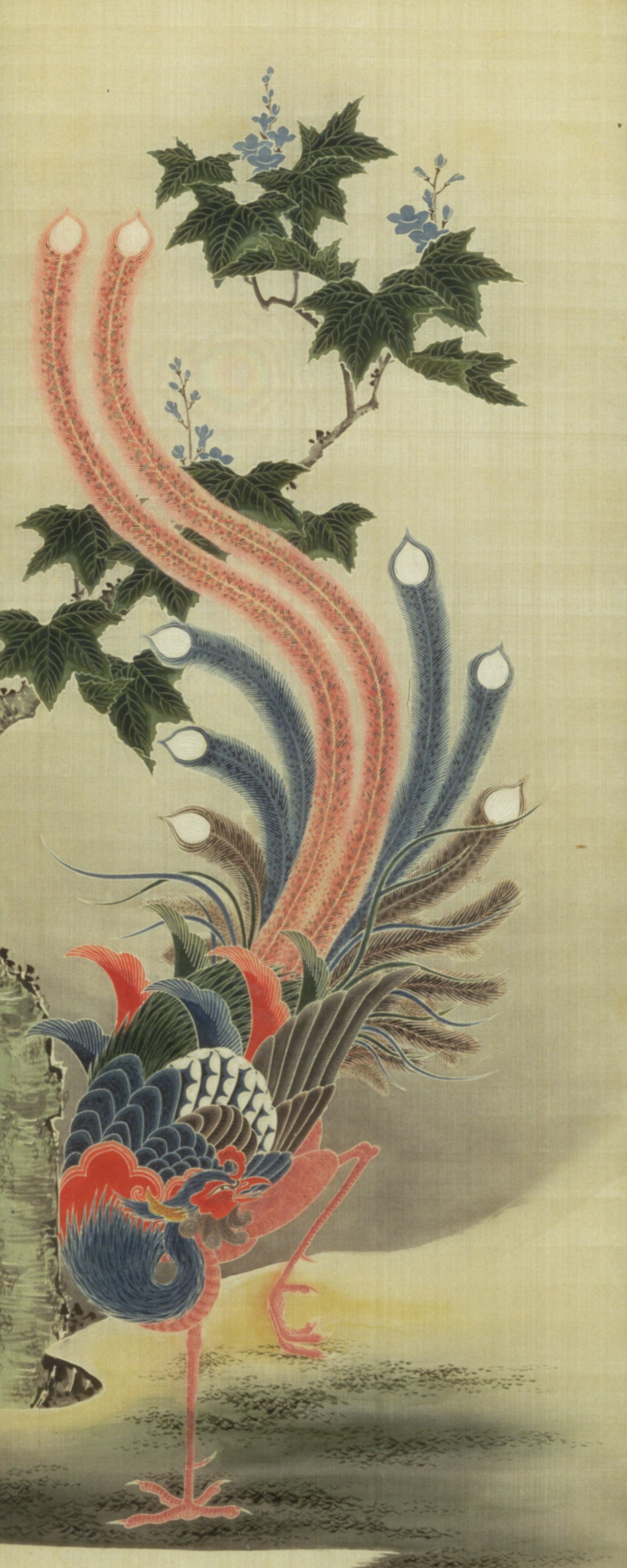
Paulownia (kiri)
A deciduous tree of the Paulowniaceae family, it has a beautiful grain, is lustrous as well as light, and resists moisture
The paulownia is a tall deciduous tree of the Paulowniaceae family. Cultivated widely throughout Japan, it. grows to heights of 8 to 15 meters, with 8-15 m and circumferences of over 1 meter. The bark is smooth and grayish white, with many lenticels. Its large leaves have broad oval shapes and long petioles, are large and grow in opposite pairs on the stem., with broad oval shapes and long petioles. Its light purple flowers are tubular and bell-shaped. They bloom in conical clusters around May to June. When its fruit matures, its husk splits into two, dispersing seeds to sail in the breeze.
The Man'yoshu ("Collection of Ten Thousand Leaves, after 759") contains mentions that Otomo no Tabito gave Fujiwara no Fusasaki a koto (six-stringed native Japanese zither) made of the Chinese parasol tree (Firmiana platanifolia) from Tsushima—a tree having the character for paulownia in its name. a reference to a yamato-goto Japanese zither made of Tsushima-grown goto (the parasol tree, which has the character for empress tree in its name) wood gifted to Fusasaki Fujiwaraby TabitoOtomo. Empress As mentioned in Makura no soshi (The Pillow Book) and Genji monogatari (The Tale of Genji), paulownia trees were grown in gardens in the Heian period (794-1185)., as mentioned in Makura no soshi ("The Pillow Book") and Genji monogatari ("The Tale of Genji"). In Chinese poetry written by Japanese, the leaves of paulownia trees are associated with provide themes related to autumn scenery., And in collections of Japanese poetry such as the Shin kokin waka shu ("New Collection of Poems Ancient and Modern"), compile many poems describeing hail or passing showers raining down on the fallen leaves of paulownia in gardens. In China, the tree is revered as the place where Chinese phoenixes birds reside, and designs featuring a phoenix paired with a paulownia tree this pairing have frequently been used on in the Japanese emperor's round-necked ho (the emperor's outer garment worn on formal occasions)robe, household furnishings, and other such fine craftsso on. In Japanese crests, paulownia were featured in the crests of the shogunal Ashikaga and Toyotomi families—crests clans' crests featuring empress trees are considered to have been conferred upon to them by the imperial family. Paulownia are featured in, and as many as 130 to 140 other types of crests, types exist, including the gosan no kiri, korin -kiri, kiri-guruma, mitsuwari -kiri, kara-giri, and kiri -cho crests.
The timber is white, has in color with a beautiful grain, and is lustrous, soft, and light. It does not absorb water, is resilient, resists fire, and tends not to warp. and is resistant to breakage as well as fire, and features minimal warping. Because of its suitability, it is Accordingly, it has been used to make furniture such as chests of drawers and hope chests, tansu dressers and nagamochi chests, as well as many other items including architecturale fittings, ceiling boards, wooden carvings, geta (clogs), battledore paddles, koto (zithers), biwa (lutes), boxes for artistic scrolls, round domaru -hibachi (round braziers), and fishing net floats. Kirisashi is a Japanese term that refers to things made with paulownia wood. furniture and apparatus made with the wood of the empress tree, or the act of making them. Kirizumi, Charcoal made from the paulownia wood, is used for sketching, artwork, as to make black gunpowder for fireworks, for blackening eyebrows, as fuel for kairo portable body warmers, and for polishing. The bark is used to make dye, and the leaves to make an insect repellent. The chief areas growing paulownia production area for the trees today are includes the prefectures of Fukushima, Iwate, Niigata, Yamagata, Ibaraki, and Tochigi. Varieties of paulownia yielding producing high-quality wood are grown, including Aizu -Kiri and Nanbu -Kiri.
Related People, Things and Events
Books
Related Works
Kiri (empress tree) patterns (wood and cloth)
Kiri patterns (metals)
Kiri patterns (kimono)
Kiri wood
Search for National Treasures and Important Cultural Properties
Videos
Past Exhibitions
| Title | shusai | Place | open | close |
|---|
Institutions Holding Related Materials
東京都墨田区両国四丁目。400年以上前の一弦琴や、江戸時代文化年間製造の箪笥などの桐製品のほか、箪笥製造のための鉋や鋸などの道具類も展示する。古典や家紋などにみられる桐と日本人との深いかかわりや、耐久性や防湿性に優れた桐の特性などを紹介する。
桐の分布、生態、木材としての特徴、家具や琴の用材、日本人の暮らしを支えた歴史などを紹介する。
桐の分布、特性、工芸品などについて簡潔に記されている。
たんすや小物家具を製作する桐工芸のなかでも、明治時代に考案された「桐木目込み細工」、またその細工が施された美術桐箱などが紹介されている。
References
- 平凡社