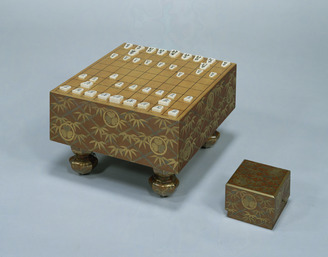
Shogi
A board game originating in Japan in which two people compete by making full use of 20 pieces
Shogi is a board game in which two people compete to take the opponent's osho (king). The game starts with 20 pieces placed on fixed positions on a board of 81 squares. There are eight types of pieces: osho (king), hisha (rook), kakugyo (bishop), kinsho (gold general), ginsho (silver general), keima (knight), kyosha (lance), and fuhyo (pawn). Each of these pieces moves differently. One big difference between shogi on the one hand and Western chess and Chinese xiangqi (Chinese chess) on the other is that you can reuse pieces taken from your opponent as your own pieces.
The model for shogi is thought to have been the ancient Indian game of chaturanga, which was like chess. This game was introduced to Japan from China during the Nara (710-792) and Heian periods, and underwent further development in Japan. In traditional times, there were several versions of shogi, with different types and numbers of pieces and different types of boards. These included "big shogi," "middle shogi," and "small shogi." It is said that in the sixteenth century, during the time of Emperor Go-Nara, shogi, an improvement of small shogi, achieved its current form.
The oldest surviving game on record was a match played in 1607 between Ohashi Sokei and Hon'inbo Sansa, a Go player. Both men received a salary from the Edo Shogunate, and Sokei became the first master of shogi. Later the Ohashi head family, Ohashi branch family, and Ito family became the three families producing later generations of shogi masters.
In the Meiji era (1868-1912), shogi lost its protection from the Edo Shogunate, and interest in shogi temporarily declined. However, around 1899 shogi news published in Yorozu choho became popular, and shogi revived. In 1924 the Tokyo Shogi Association, the predecessor of the current Japan Shogi Association, was born.
Related People, Things and Events
Books
Shogi Books
Related Works
Videos
Institutions Holding Related Materials
所在地は東京都渋谷区に所在。将棋会館1階の売店ではオリジナル商品を販売している。
山形県天童市にある資料館。将棋の歴史に関する資料、駒の制作過程などの展示がある。
The National Diet Library (NDL), founded in 1948, is the library which belongs to the Diet. The NDL assists the activities of the National Diet. The Library collects and conserves materials and information both from Japan and abroad, serving as a foundation of knowledge and culture and providing library services to administrative and judicial entities and Japanese citizens.
As Japan’s representative museum, Tokyo National Museum collects, preserves, displays, and researches the cultural properties of Asia with a focus on Japan, and also provides educational programs.
Aichi Prefectural Museum of Art was founded as the successor of the Aichi Prefectural Art Gallery, which originally opened in Sakae, the center of Nagoya City, Aichi Prefecture, in 1955. The museum opened in 1992 as part of the Aichi Arts Center, an urban cultural complex, and has established a wide-range collection of approximately 8,000 items, centered on works of art of the twentieth century. The Museum has also organized numerous exhibition of a wide-range of themes. The Museum has actively worked to develop and communicate new aspects of art and culture to the public, based on its core mission to serve as the primary art museum of the Chubu region.
External Links
「将棋」の歴史、対局の予定と結果、棋士データベースなど、将棋に関するあらゆる情報を載せている。
平成19年に催された「将棋展」をの図版と解説が公開されている。
References
- 日立デジタル平凡社,平凡社