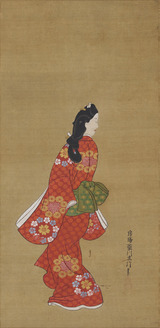
Hishikawa Moronobu
A painter who helped develop woodblock prints in their early days; most famous for his composition Beauty Looking Back d. 1694
Hishikawa Moronobu was a woodblock print artist of the early Edo period. He was the founder of the Hishikawa School, which established woodblock prints (ukiyo-e) as an art form. He was born in Awa Province (present-day Chiba Prefecture) into a family that engaged in embroidery as a family business. While the year of his birth is not known, it is known that his given name was Kichibei. In his later years, when he took the tonsure and entered a Buddhist monastery, he adopted the religious name Yuchiku.
In the Kanbun era (1661-1673) he went to Edo and studied paintings of the Kano and Tosa schools, and late in the era he began working as an artist and book illustrator. The first known signed book of his is the illustrated book Buke hyakunin isshu (The Samurai One Hundred Waka Poems by One Hundred Poets), published in 1672. However, most of the illustrated books that he worked on are unsigned. He worked on many illustrations for books like kanazoshi (books written in kana) and jorurui lyric books (jorurui being storytelling accompanied on the samisen).
Even after the beginning of the Enbo era (1673-1681), he continued making illustrations for books, but he also established his own new, unique form: illustrated books whose main attraction is the illustrations. This is especially apparent in the book Yamato-e tsukushi (The Complete Book of Yamato-e, 1680), where the illustrations make up about three quarters of the book.
He also left a legacy of many original works in a variety of genres, including original paintings, screens, picture scrolls, and hanging scrolls. His original painting Mikaeri bijin (Beauty Looking Back) is among his finest works.
He also produced many pupils, among them his sons Morofusa, Moronaga, and Moroyoshi, as well as Koyama Moroshige, Hishikawa Tomofusa, and others.
He died on the 4th of the sixth month of 1694 in his house in Muramatsu-cho, Edo (the present-day Higashi Nihonbashi, Tokyo). His remains are buried at the temple Betsugan-in in his hometown of Hota, Chiba.
Related Gallaries
Books
Related Works
Past Exhibitions
| Title | shusai | Place | open | close |
|---|---|---|---|---|
Institutions Holding Related Materials
師宣の生誕地である千葉県安房郡鋸南町にある記念館。師宣の作品が多数展示される。
埼玉県坂戸市の城西大学内にある美術館。「虫籠美人図」「見立石山寺紫式部図」など、師宣の肉筆作品を所蔵する。
The National Diet Library (NDL), founded in 1948, is the library which belongs to the Diet. The NDL assists the activities of the National Diet. The Library collects and conserves materials and information both from Japan and abroad, serving as a foundation of knowledge and culture and providing library services to administrative and judicial entities and Japanese citizens.
As Japan’s representative museum, Tokyo National Museum collects, preserves, displays, and researches the cultural properties of Asia with a focus on Japan, and also provides educational programs.
External Links
サントリー美術館のコレクションデータベース。「上野花見歌舞伎図屛風(伝菱川師宣)」「新板小袖御ひいなかた」を見ることができる。
千葉市美術館の収蔵品データベース。「隅田川・上野風俗図屏風」などを見ることができる。
- 日立デジタル平凡社,平凡社
- 国際浮世絵学会 編,東京堂出版
- 清水澄 編,美術倶楽部鑑定部