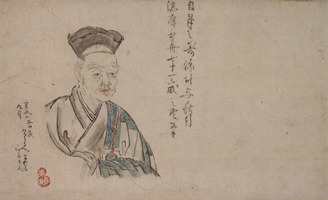
Sesshu
An artist monk of the Muromachi period who traveled to Ming China and in his career painted masterful monochrome ink paintings
1420–c.1506
An artist monk of the Muromachi period (1392–1507) who was a master of monochrome ink painting (suibokuga) in medieval Japan. He was born in Bitchu Province (currently Okayama Prefecture) into, according to one theory, the Oda family. His real name was Toyo; Sesshu was his pseudonym. He entered into priesthood at a young age by going to Kyoto and studying under Zen master Shuto Shunrin of Shukoku Temple. He is believed also to have learned art during this time from the Zen monk Shubun of the same temple. From 1460 to 1466, Sesshu visited Yamaguchi, Suo Province (currently Yamaguchi Prefecture), which was Daimyo Norihiro Ouchi’s base for trade between Japan and Ming China. Under Norihiro’s patronage, he lived at Unkoku Monastery, located in this region. In 1467 Sesshu boarded a trading ship and traveled to Ming China. He learned painting from original works of prominent families in various locations, while also sketching nature scenes and genre paintings to hone his skills. Though he was unable to find any exceptional teachers while in China, it is presumed that his experiences during this visit greatly contributed to his subsequent development as a painter. After his return to Japan in 1469, Sesshu continued to create art in Oita, Bungo Province (currently Oita Prefecture), at Unkoku Monastery in Yamaguchi (which was rebuilt by Masahiro Ouchi), and also as he traveled to various places from time to time, leaving us a large number of masterpieces. In his painting style, he actively absorbed the style of the Chinese imperial academy (intai-ga) of the Song and Yuan dynasties, and in particular, he closely followed the styles of China’s Xia Gui (fl. 1195–1224), Li Tang (c. 1050–1130), Liang Kai (c. 1140–c. 1210), and the monk Muqi Fachang (1210?–1269?). He greatly influenced future schools of art, such as the Kano and Hasegawa schools. Sesshu’s numerous seminal works include Sansui chokan (Long Scroll of Landscapes; Mori Museum), Haboku sansuizu (Broken Ink [pomo] Landscape; Tokyo National Museum), Shuto sansuizu (Landscapes of Autumn and Winter; Tokyo National Museum), Shiki sansuizu (Landscape of the Four Seasons; Bridgestone Museum of Art), and Amanohashidate zu (View of Amanohashidate; Kyoto National Museum).
Related People, Things and Events
Books
Bibliographies
Related Works
Cultural Properties of Japan
Videos
Past Exhibitions
| Title | shusai | Place | open | close |
|---|---|---|---|---|
External Links
島根県益田市に所在。雪舟が永眠したといわれる雪舟廟大喜(たいき)庵に隣接し、平成2年(1990)に開館。雪舟と益田の歴史を展示、紹介しています。
大阪府大阪市都島区に所在。重要文化財の「雪舟自画像(模本)」を所蔵しています。
As Japan’s representative museum, Tokyo National Museum collects, preserves, displays, and researches the cultural properties of Asia with a focus on Japan, and also provides educational programs.
Kyoto National Museum collects, preserves, displays, researches and provides educational programs focusing on cultural properties from Heian- through to Edo- period Japan, when the capital was located there.
京都国立博物館HPのうち「博物館ディクショナリー」の「絵画のおはなし」より。
小学館が運営する日本文化の入口マガジン「和楽web」より。雪舟の生涯と代表作を紹介している。
東京都中央区京橋に所在するアーティゾン美術館HPより。コレクションのうちの「コレクションハイライト」として、雪舟筆「四季山水図」の春幅・夏幅・秋幅・冬幅を画像とともに紹介している。
NHK for Schoolより。
岡山県総社市HPのうち、総社市公式観光WEBサイト「総社観光ナビ」より。同サイトに「雪舟さんものがたり」も掲載されている。
References
- 雪舟 [画],島尾新 著,小学館
- サンプルページ「雪舟」の項
- 「雪舟等楊」の項
- 「雪舟等楊」の項
- 歴史学研究会 編,岩波書店